Wednesday, September 12, 2012

6th Generation iPhone - iPhone 5

The iPhone 5 is slightly bigger than its predecessors

The sixth generation iPhone was just unveiled several hours ago. Dubbed the iPhone 5, it is actually the 6th iPhone down the line from the 1st model.

As expected, Apple upgraded its most popular product inside out. While it retains its shape and general cosmetic appearance, the iPhone 5 is actually slightly longer and thinner than the 4s and now has an anodized aluminum back (same material used in Apple's notebooks). IPhone 5's new length accomodates its 4 inch (diagonal) widescreen fingerprint-resistant display with 1136-by-640-pixel resolution. The headphone jack has also been relocated to the bottom, beside the built-in speaker and the more durable "lightning connector" (w/c replaces the older 30-pin connector from previous models).

The new phone is 4G LTE capable and supports advanced networks such as HSPA, HSPA+, and DC-HSDPA. It has Dual-band 802.11n wi-fi connectivity for faster browsing and downloads, up to 150 mbps. The new A6 chip offers better graphic performance and is more efficient, twice as fast as the A5 chip in the 4s.  The camera in the iPhone 5 remains at 8 megapixels with essentially the same hardware specs, but has better low-light performance (2 stops better), improved noise-reduction and improved video image-stabilization. It also has a new panorama feature - with one smooth motion you can shoot 240 degree high-resolution panoramas, up to 28 megapixels.

For details on the iPhone 5's features go to:  http://www.apple.com/iphone/features/

Would I upgrade? I probably would, since I have upgraded from every version of the phone since its inception. But I am in no hurry. I am happy with my current 4s model and the features on the new iPhone 5 can wait until after the Christmas rush is over.

--image from Apple.com

Sunday, September 2, 2012

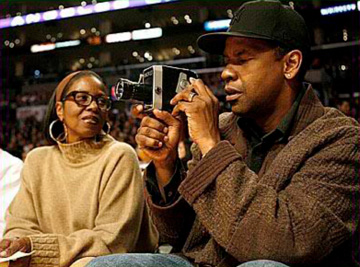
Celebrities And Their Cameras

Celebrities are normally found in front of the camera.  But in this collection of celebrity photographs I collected from the internet, we see them behind the camera-- being photographers themselves.  I thought it would be interesting to put these pictures together in one exhibit.  There seems to be a personality fit in their choice of camera formats and brands.  What do you think?
 
Large Format for Angelina Jolie 
 
Canon DSLR for Madonna
 
Classic Nikon for Kristen Stewart 
 
Avril Lavigne likes Canon
 
Matt Damon and Ben Affleck horsing around with a Hasselblad

James Dean and his Rollei TLR 

Denzel Washington using a classic 8mm movie camera
 
Julia Roberts uses film in her Leica
 
Brad Pitt likes using a classic Leica

Monday, August 20, 2012

The Tragedy of Tony Scott

Tony with his 3rd wife, actress Donna Wilson and their twins.

Hollywood is again in shock... as one of its best and brightest takes his life on the pinnacle of his career.

Hollywood Blockbuster Director/Producer Tony Scott died yesterday (Aug.19), after jumping off the Vincent Thomas Bridge in San Pedro, near the Los Angeles Harbor.  According to eyewitness reports, they saw a man around noon park his Toyota Prius, climb the 8 foot fence and jump from the bridge.  Tony's body was found 3 hours later by search and rescue teams.  They found a suicide note in his office.  He was 68 years old.

The Vincent Thomas Bridge where Tony committed suicide

It has been widely reported that Tony has an inoperable brain cancer (autopsy results are still pending), but according to TMZ, Scott's wife told investigators that the rumours are absolutely false and that Tony did not have any other severe medical issue that would have cause him to take his own life.  Friends close to him (including a host of Hollywood celebrities who have worked with him) also express their shock at the suicide, citing that Tony Scott was one of the most positive, energetic man they knew.

Tony (left) with brother Ridley (podium) accepting an award

Tony is the business partner and younger brother of Director/Producer Ridley Scott.  His film directing work include:  "Top Gun," "Beverlyhills Cop 2", "Days of Thunder", "The Last Boy Scout", "True Romance", "Crimson Tide", "Enemy of the State", "Spy Game", "Man On Fire", "Domino", "Déjà Vu", "The Taking of Pelham 123" and "Unstoppable".  He directed more than a thousand TV commercials.  He also produced movies and television shows including "The Good Wife", "Gettysburg", "Numb3rs", "Labyrinth" and the mini-series "Coma".  Tony had more than 30 projects in development when he died, including several directing projects like "Top Gun 2," "Narco Sub," "Emma's War" and "Hell's Angel."

Hollywood and film fans worldwide mourn the loss of this wonderful filmmaker.  We could only wonder at what possessed him to take his own life at such a prolific stage.  A thrill-seeker by nature and a director who portrayed characters winning against all odds, Tony opted to end his life on his own terms.  Is it tragic or is it heroic?  Only he will know.  Ron Howard simply sums it all up, "No more Tony Scott movies. Tragic day."

Friday, August 10, 2012

The Education Of A Photographer

"The Education of A Photographer" is a great read for any photographer, whether pro or amateur.  The book is a collection of articles by some (and on some) of greatest practitioners of the Art:  like Diane Arbus, Henri Cartier-Bresson, Harry Callahan, Lee Friedlander, Irving Penn, Aaron Siskind, Garry Winogrand and many others.

Compiled by Charles Traub (photographer and Chair, School of Visual Arts' MFA Photography Dept.), Adam Bell (photographer) and Steven Heller (art director and Co-chair, School of Visual Arts' MFA Designer Prog.), the book offers an eclectic collection of articles on the Art and practice of Photography -- highlighting perspectives from all the photographic disciplines as well as from the related fields of design, graphics, typography, illustration and commercial media.

Here is an excerpt from the article by Henri Cartier-Bresson:

"For each of us space begins and slants off from our own eye, and from there enlarges itself progressively toward infinity.  Space, in the present, strikes us with greater or lesser intensity and then leaves us, visually, to be closed in our memory and to modify itself there.  Of all the means of expression, photography is the only one that fixes forever the precise and transitory instant.  We photographers deal in things that are continually vanishing, and when they have vanished, there is no contrivance on earth that can make them come back again.  We cannot develop and print memory.  The writer has time to reflect.  He can accept and reject, accept again; before committing his thoughts to paper he is able to tie the several relevant elements together.  There is also a period when his brain "forgets," and his subconscious works on classifying his thoughts.  But for photographers, what has gone is gone forever.  From that fact stem the anxieties and strength of our profession.  We cannot do our story over again once we've got back to the hotel.  Our task is to perceive reality, almost simultaneously recording it in the sketchbook which is our camera."

--Book graphic and quote from "The Education of a Photographer," Allworth Press, 2006.

Thursday, August 2, 2012

Art Center College and 30 Years of "TRON"

The Movie 'Tron' with Jeff Bridges

I am a proud product of the two colleges I attended: USC and the Art Center College of Design.  So everytime I find an interesting article related to either school, I always highlight it in this blog.

This article is from the Art Center College of Design's Blog, Dotted Line:

This year marks the 30th anniversary of Disney’s Tron, the movie which introduced a generation to light cycles, identity discs and a glowing spandex-clad Jeff Bridges. It was also the first time most filmgoers marveled at computer-generated special effects.

The history and evolution of Tron wouldn’t be the same without the work of a number of members of the Art Center community who were involved in the original 1982 film - Syd Mead (TRAN '59), its 2010 sequel Tron: Legacy - Eric Barba (TRAN '92) and the current Disney XD animated series Tron: Uprising - Annis Naeem (current ENT. Design).

Friday, July 27, 2012

The Romantic Manifesto By Ayn Rand


Ayn Rand, the writer widely known for her best-selling novels: "The Fountainhead" and "Atlas Shrugged," is also a renowned philosopher credited for developing a philosophical system she called "Objectivism."  An advocate of Individualism and free-market capitalism (she grew up during the Bolshevik Revolution in Russia), she is often misunderstood as an extreme Conservative, due to her associations with the Republican Party.  But she specifically clarified her position as follows -- "I am not primarily an advocate of capitalism, but of egoism; and I am not primarily an advocate of egoism, but of reason. If one recognizes the supremacy of reason and applies it consistently, all the rest follows."  She vehemently opposed statism, which she understood to include theocracy, absolute monarchy, Nazism, fascism, communism, democratic socialism, and dictatorship.

In her book, "The Romantic Manifesto," she tackles the subject of "Art," and clearly defines its nature and its place in the order of human endeavor.  I highly recommend it to every Artist (no matter what discipline) as a definitive philosophical treatise on the topic of Art and its purpose in our lives.  Like all philosophical expositions, this aesthetic manifesto suffers from the author's own biases and limitations (photography and cinema were not even considered in her list of Arts) for Ayn Rand is human after all.  But if we are mindful of these minor flaws, we can readily distill the brilliance of her discourse.  Reading it gave me a clearer understanding of my role as an artist, and it also offered me an outline of an ideal to strive for in my own work.

Here is a brief excerpt from the book.  I always marvel at the clarity and the precision of Ayn Rand's statements and definitions:

Thursday, July 19, 2012

Two Legendary Actors Passed Away Last Week

Philippine Comic Dolphy and American Actor Ernest Borgnine

Two favorite actors from my youth passed away last week.  Filipino Actor/Comedian, Dolphy died on July 10 in Manila at the age of 83; and American Actor, Ernest Borgnine died on July 8 in Los Angeles at the age of 95.  Both had long and illustrious careers (in their respective countries) in cinema, television and the stage.  I will forever treasure the wonderful characters they artfully portrayed on television and on film as wonderful memories of my childhood-- particularly John Puruntong (Dolphy) and Quinton McHale (Borgnine), as well as the infinite roles they starred in like: Facundo Alitaftaf (Dolphy), Kapten Batuten (Dolphy), Captain Barbell (Dolphy), El Pinoy Matador (Dolphy), Tansan (Dolphy), Detective Mike Rogo (Borgnine), John Corbis (Borgnine), Sheriff Lyle Wallace (Borgnine), Harry Booth (Borgnine) and the Roman Centurion in Jesus of Nazareth (Borgnine). 

Saturday, June 30, 2012

Two Master Storytellers Succumb to Leukemia

Writer/Filmmakers Mario O'Hara and Nora Ephron

Two of the writer/directors I greatly admired passed away due complications brought about by Leukemia last Tuesday (June 26); just a couple of hours from one another, half a world apart.  Award-winning Filipino Filmmaker (writer, director, producer) Mario O'Hara was admitted to a Manila hospital last June 15 for leukemia treatment (he refused blood transfusion, but underwent chemotheraphy), but died eleven days later at the age of 68.  Popular American Journalist/Filmmaker Nora Ephron died several hours after in a hospital in New York, of pneumonia from complications brought about by acute myeloid leukemia -- a condition she has been suffering from for a couple of years.  She was 71.

I join the thousands of fans and cinephiles the world over, in mourning the loss of these two talented artists.  Though they may have departed in body, their spirits live on in their art (body of work), and will continue to be a precious legacy for all of us to enjoy and learn from.  

Tuesday, June 5, 2012

Nick Ut's "Napalm Girl"


The Pulitzer Prize winning photograph dubbed "Napalm Girl," turned 40 this month.  When it was first published in June 8, 1972, 21 year-old Associated Press photographer Huynh Cong Ut (professionally know as Nick Ut) had no clue that his photo would one day become one of the most famous images of the 20th century, and how it will have a lasting impact on his life.

Nick Ut, then and now

Nick Ut became a photojournalist at the young age of 16, just after his brother Huynh Thanh My, an Associated Press photographer, was killed on assignment.  He was mentored by the legendary photojournalist Horst Faas (who recently passed away).

Nick was with some South Vietnamese troops on patrol near Trang Bang, when he witnessed the aerial bombing of a civilian village.  A South Vietnamese Skyraider plane bombing suspected Viet Cong hiding places, accidentally dropped its flaming napalm on South Vietnamese troops and civilians.  Surprised by the attack, he immediately trained his camera on the burning village.   Soon after, he heard screams from the villagers, among them children, running away from the devastation.

Another shot by Nick of the same scene

Among the panic-stricken children were Kim Phuc, her two brothers and her cousins.  Nine year-old Kim Phuc ran naked after discarding her burnt clothes wailing, "Too hot! Too Hot!"  Blobs of  napalm had incinerated her clothes and scorched her skin like jellied lava.  In her fear and confusion, her only thought was how ugly she's become and how she will never be the same again.  Screaming in panic, she ran out from the burning village into the main road, oblivious to everything else around her.

Friday, May 18, 2012

"Blow Job" by Tadao Cern

This is something I found in Facebook... A series of portraits by Lithuanian photographer Tadao Cern (Tadas Cerniauskas) using "air blasts," to create comical caricatures of everyday people.  The series was created during the Design Weekend in Vilnius. Visitors to the Tadao Cern studio were invited to participate in a live photo session.

It's graphically hilarious and visually novel.  It reminds me of the wonderful times I had as a child, when I would stick my head out of our speeding car to experience the blast of wind distort my face in weird contortions.

Here is a sampling of "Blow Job":


For more information on "Blow Job" or Tadao Cern, please go to www.tadaocern.com or Facebook - http://www.facebook.com/media/set/?set=a.364606033586614.77800.151290258251527&type=3

--all photos property of Tadao Cern

Tuesday, May 8, 2012

My Favorite iPhone Photo & Video Apps.

Playing my Traveler guitar using my iPhone as an Amp. (photo by Anne)

I have been an iPhone fan since its inception and yes, I am one of those freaks that have gone through all five versions (iPhone 1, 3G, 3Gs, 4 and now the 4s) of this popular Smart Phone.  I just love the versatility of this gadget-- "a digital Swiss Army Knife."  With one tool, I am always carrying a virtual office wherever I go-- my telephone, my computer, my music and most importantly (as a photographer), a camera/videocamera.

I shot and edited this photo using the 1st iPhone

I shot and edited this photo using the iPhone 3G

When I got my first version of the iPhone, I just used the camera for casual snap-shots.  At 2.0 megapixel, the camera was just too "light" to use for anything more serious.  Since the phone came with some great Apps., I was always eager to upgrade.  I began using the iPhone for my Fine Art work after upgrading to the 3G.  There was only a megapixel difference, but I was able to clearly print my photos up to 8" x 10" (using the Camera Bag App.).  You can see the results of this initial foray in my "Grounded Series." Now with the 4s' 8 megapixel camera, I can leave my trusty compact Leica D-Lux 3 at home.

Here is an example of a photo I shot and edited with the iPhone 4s.

Although there have been a slew of lens attachments and gadgets that have been made to enhance the performance of the iPhone's camera, I never really used any of them personally.  Carrying attachments bulkier than the phone itself defeats the portability and ease the gadget offers.  My main attraction to the iPhone aside from its obvious convenience, has always been the availability of wonderful Apps.  To date, I have more than 400 Apps. on my current iPhone.

Here are some of photo and video Apps. I use regularly:

Friday, April 13, 2012

Canon's New Ultra Cameras: 1Dc and C500

The Canon Cinema EOS family with the new C500 and the 1Dc

Yesterday, Canon, Inc. announced two new cameras they will be introducing at this year's NAB - the Canon EOS 1Dc and the Canon EOS C500.  The two new EOS Cinema EOS cameras (Super 35mm) are 4K capable, with support for uncompressed Canon RAW file (still for 1Dc and motion for C500).
   

After the success of the hybrid 5D MKII and the 7D with Indie Filmmakers, Canon shifted its R&D to its products' video capabilities.  Last year, it created a new product line called Cinema EOS with the introduction of the C300.  Aside from pro-class cinema/broadcast cameras, the EOS Cinema family also features new pro-cinema lenses.  Faced with a shrinking consumer camera base (mainly due to cellphone cameras), the company is clearly shifting its focus to the professional motion imaging market.

Monday, April 2, 2012

Stewart Sy's Wild World

Stewart capturing beauty underneath the waves

Stewart Sy's love affair with nature and the wild started at a very young age.  Growing up in the Philippines, he fondly recalls spending a lot of his free time pouring over the catalogued back issues of National Geographic in the Xavier School library (we were classmates), dreaming of one day visiting all those exotic places and experiencing the grandeur of the wilderness captured by the magnificent NatGeo photographers.  After graduating from college (DSLU) in 1989, Stewart migrated to Canada to follow his family.  In Vancouver, he discovered a dive shop a few blocks from their house.  He signed up for a course, and the rest is history -- he has been diving now for more than 20 years.

Stewart discovered photography pretty much the same way, by accident.  People were curious about his new diving hobby and were badgering him about it.  So he finally decided to bring a camera with him during his diving expeditions to capture some of the beautiful things he saw underwater.  This second hobby also became an obsession.  Not only did he become a diving photographer, he liked photography so much that he became a part-time freelance commercial photographer too.  Aside from this, he runs two photography related businesses:  one that offers professional digital scanning services; and the other, a dealership offering aquatic photographic equipment and accessories.


Stu and I lost contact after we graduated from High School, so I was not aware of his photography until we reconnected in Facebook last year.  Stewart would post some of his work once in a while, and I was soon impressed by the consistency of his vision and skill.  He has an unmistakable artistic 'eye.'  According to him, he drew and doodled a lot when he was younger, but he never formally studied photography or any other art form.  Amazing, is the first word  that comes to mind, whenever I think of his photographs. 

I interviewed Stewart to get a better insight into his photography, his vision and his art:

Saturday, March 10, 2012

Is It The Camera Or Is It The Photographer?


Should the photographer or the camera be credited for the quality of a photograph?  The answer to this question seems obvious (to me), yet photographers often encounter statements from people who readily tell them, "I love your pictures, you must have a great camera" or "your photos are beautiful, that expensive (professional) camera is certainly worth what you paid for."  It seems that most people have a general impression that photographers are only as good as their camera, and that a newer model, with more bells and whistles, will actually do miracles for anyone's photography-- a myth propagated and fueled by Camera manufacturers.

This erroneous belief started more than 100 years ago when George Eastman simplified the photographic process by inventing the first Kodak Camera.  "You press the button, we do the rest" promised George Eastman in 1888.  Everyone, wherever they went (since it was also portable), could easily take a picture with a Kodak -- essentially a shoebox sized light-tight box with a simple shutter, pre-loaded with his newly invented rolled-film (enough for 100 exposures).  Before Eastman, photography was a laborious occupation, exclusive to professionals who used cumbersome cameras and individually prepared glass plates.  The Kodak camera brought photography to the masses, and for the first time, knowledge and experience in the craft of photography took a back seat.

Since 1888, developments in photographic technology and imaging had made it easier and easier for all of us to take better photographs-- from point-and-shoot cameras with flash, to faster film stock and even auto-focus.  The current digital technology has even reached the point (in my opinion), where it is almost impossible to take a badly exposed photo.  Our current digital cameras (or cellphones) are not simple boxes anymore, but micro-sized pro-grade cameras that have variable shutters, irises, lenses and programmable flash guns that can all be automatically adjusted by computer.  "You press the button, and the camera literally does the rest."  In this day and age of the digital camera, everyone is at least, a competent photographer.

So has the camera finally replaced the photographer, after 120 years of technological advances?