Showing posts with label commercial photography. Show all posts

Sunday, December 20, 2015

Merry Christmas


MERRY MERRY CHRISTMAS to everyone!!!!
 
As you all know by now, Christmas came early to me in the form of my first Feature Film "Dagsin." Please forgive me if I have not been updating this blog as often as I should these past few months, but I have been really busy...
 
Me with my new toy.
 
It has been a wild roller-coaster ride so far, but Anne (Producer) and I have somehow managed to keep our ship afloat. "Dagsin" has been plagued with all kinds of problems from the onset of Preproduction and each shooting day has been challenging-- Two of our actors have been ill and hospitalized, another decided to drop out in the middle of filming, the local government threatened to shut our production down more than once, we had to iron out a land ownership dispute situation for another location, and on top of all that, we had to fire someone from our team for gross misconduct and anomalies regarding the budget-- these are just the major ones! Talk about Murphy's Law... We are taking this all in stride because it has always been our goal to deliver the best work we can, once we set out to execute a project!
 
I am very grateful that I have finally been given the opportunity to finally make my movie and I thank God everyday for this blessing. I love making movies and I plan to keep doing it for as long as I can! 
 
I have not forgotten that this is also a photography blog, despite my other interests. So I am posting some of my still-photo work in the movie. I just realized recently that it is hard to be a director, cinematographer and photographer all at the same time, so I have recruited a second DP as well as a BTS photographer in "Dagsin" to complement my work.
 
Here are two promotional photographs I shot for "Dagsin," which I am giving to the actors as Christmas gifts:
 
Tommy Abuel, Lotlot De Leon and Sue Prado for Dagsin
 
Alex Diaz, Janine Gutierrez and Benjamin Alves for Dagsin

Saturday, February 14, 2015

Photo Mural Commission - Part 3


"Trinity" an original photo-triptych by Atom Magadia


"To see a World in a grain of sand
and Heaven in a wild FLOWER
Hold Infinity in the palm of your hand
and Eternity in an hour..."
William Blake
 
"There is Nothing you can see
that is not a FLOWER..."
Matsuo Basho
 
"No more words
In the Name of this Place
we drink in with our breathing
Stay quiet like a FLOWER
so the Nightbirds will start singing..."
Jalal ad-Din Muhammad Rumi

 
Beside the actual artwork

Friday, February 6, 2015

Canon's New High Resolution 5DS & 5DS R


My long wait is finally over! Canon just came out with cameras I actually want... and need.

The new Canon EOS 5DS R and its twin 5DS

As a commercial studio and fine-art photographer, image resolution is critical to my work. The last time I was this excited about a camera was 13 years ago when the Canon EOS-1Ds first came out; arguably the 1st successful full-frame DSLR, after the pioneering Contax N Digital failed. Its successor, the 1Ds Mark II, has been giving me wonderful high quality images for my magazine and newspaper assignments ever since.  But I still have to rent digital backs for my Mamiya RZ67 Pro IID and my Sinar P2 whenever I have high-resolution (Billboard Advertising, Wall Mural) projects. Not any more... 
 
The Canon 5Ds and 5DS R are 50.6 Megapixel, full-frame DSLRs!
 
The two new high-resolution models are exactly alike, except for the absence of the Low-pass filter on the 5DS R model. Both are equipped with a newly designed 50.6 megapixel full-frame CMOS sensor with dual Digic-6 processors; a 61 point High Density Reticular Auto Focus; full HD (1920 x 1080) 30p video with time-lapse function; continuous shooting up to 5 fps; dual card slots (1 CF + 1 SD); an intelligent viewfinder with 100% coverage; a 3.2 inch Clear View II LCD monitor (170 degree viewing angle, 1,040,000 dot VGA); and a magnesium-alloy body. Additional features include an EOS Scene Detection System with a 150,000 pixel RGB+IR Metering Sensor for more accurate exposures; an advanced mirror control mechanism and selectable shutter release time lag that helps suppress camera vibration for added image clarity; an Anti-flicker function to compensate for flickering light sources and assist in acquiring consistent exposure and color; and user selectable 1.3x and 1.6x crop capabilities for added flexibility. The normal ISO range for both cameras is 100-6400, with expanded speeds up to 12800-- pretty decent for studio applications.
 
The absence of the Low-pass filter on the 5DS R is an option reserved for specialized applications that need extra-crisp focus, like high-resolution advertising, landscape and fine art photos. There have been a lot of Canon users in the past couple of years who have experimented with removing the LPF from their stock 5D and have claimed an improvement on their camera's sharpness and overall resolution. Canon is now offering that option in the 5DS R.
 
To everyone familiar with my blog, you all know that I just recently acquired my fourth complete digital camera system (Fuji X) for my everyday "Street" and travel work so I do not have the budget this year for this camera. But I am dusting my Canon Lenses in anticipation... 
 
I am also anxiously awaiting the launch of the 5D Mark IV, the successors to the 1Dx and 1Dc models, as well as the "mystery Canon camera" that has been rumoured (3D?). But for my current needs, these two models are already sufficient. Thank you Canon!!!!

Here is a video by the Canon Digital Learning Center on the 5DS and the 5DS R:

 
--Images and video taken from Canon, USA    

Friday, January 23, 2015

Photo Mural Commission - Part 2

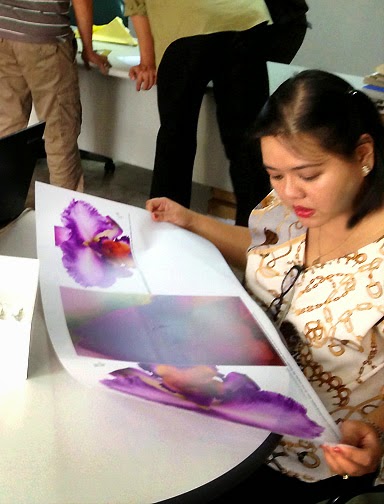
After shooting flowers in my studio last week, I tweaked and converted my RAW shots in Adobe Lightroom, then proceeded to edit the images in Adobe Photoshop to create the mural's abstract collage files.
 
Anne (my wife/business partner) and I spent the whole week gathering proposals and bids from a dozen of the Manila's premier digital printers. But we still ended up using our regular large format contractor Pixografx, because no one else was able to match their quality, reliability and professionalism (a rare virtue in these parts), specifically when it involves dimensions of this size-- 4 x 6.5 feet.
 
We met with them yesterday, to proof and finalize the print...      
 
Discussing the nuances of the art-piece with imaging expert Rain Lacson...

When I was asked to do this mural and was told to come up with the art, I originally proposed doing nudes (w/ one or two models) in a surreal composition. But it was flatly rejected. The clients countered that the commissioned artwork will be prominently displayed in their dining room, so they would prefer a less controversial piece-- preferably something less upsetting to their gastronomic sensibilities.

Test printing on different papers to get the right texture and ink clarity.
 
During one of our meetings, the clients mentioned admiring my "Butterfly" series, which features flowers and insects. Unfortunately, most of those images were shot ten years ago with a low-resolution camera and would not work with the size of the proposed mural. So I suggested shooting new high-resolution floral images for the project without the butterflies (w/c would require field work and more time), and they happily agreed.
 
Anne helping me  proof for printing...

Friday, January 16, 2015

Photo Mural Commission

I have been locked up in my studio doing flower photography, so I do not have much to show in terms of "Street" work this week.
 
Pope Francis arrived yesterday for an official visit and Metro-Manila is on holiday for several days (in anticipation of traffic), which gave me unexpected time-off to begin work on a mural project. The Philippines is a predominantly Catholic nation and the presence of  the Vicar of Christ in our country has been known to cause wide-spread hysteria, coupled with mass public congregations.
 
"Look Mom, It's Pope Francis!"
 
I recently received a commission to do a fine-art photo mural for a private residence (4 feet by 6.5 feet), so I am experimenting with some flower photography because the client expressed a fondness for floral art. I still have to figure out what to do in the final collage-- which I will eventually assemble in Photoshop (possibly with other elements), so there is nothing definite yet. But here is a sampling of some of the raw shots that came out from the shoot...

Sunday, May 12, 2013

Restoring Old Photos

"Restoring old photographs" is an art in itself.  In my experience, it is a combination of photographic knowledge and painting skills.  I am not a professional restorer in the strictest sense of the word, but I do use restoration/retouching techniques in my work as a commercial photographer.  I have to warn you that I did not take any seminars to learn what I am about to share here.  So my methods might be a tad unconventional, but they do the work and get the job done.
 
Hair can be tricky to restore. Pay attention to highlights and shade.
 
By definition, "Photo Restoration" is the practice of restoring photographs that have been damaged by nature, harsh handling, the deterioration of the medium and/or plain neglect.  Before the advent of Photoshop (and other similar photo-manipulation software), restoring old photographs were only undertaken by professional restorers and serious hobbyists, because it required manual hand-painting or retouching with photo-safe dyes on the actual print.  It was costly and time consuming.  But digital technology changed all that.  By scanning the original print or negative and working on a digital facimile, we are able to restore the image without damage to the originals.  Through this process, we are not only able to restore but also improve the quality of the picture -- in terms of color, contrast and resolution.
 
Anyone equipt with Photoshop (any version or any similar software) can restore old photographs easily.  All you need beyond this basic software, is a good digital scanner and a lot of imagination.  Being good at drawing and painting helps, but visual acuteness is more paramount.  Because in the end, how a photograph ends up looking will all depend on an individual's personal taste -- something no one can ever teach.  So I limit my discourse to purely technique here.
 
I had to recreate the whole right-side of her face because of the damage.

Friday, August 10, 2012

The Education Of A Photographer

"The Education of A Photographer" is a great read for any photographer, whether pro or amateur.  The book is a collection of articles by some (and on some) of greatest practitioners of the Art:  like Diane Arbus, Henri Cartier-Bresson, Harry Callahan, Lee Friedlander, Irving Penn, Aaron Siskind, Garry Winogrand and many others.

Compiled by Charles Traub (photographer and Chair, School of Visual Arts' MFA Photography Dept.), Adam Bell (photographer) and Steven Heller (art director and Co-chair, School of Visual Arts' MFA Designer Prog.), the book offers an eclectic collection of articles on the Art and practice of Photography -- highlighting perspectives from all the photographic disciplines as well as from the related fields of design, graphics, typography, illustration and commercial media.

Here is an excerpt from the article by Henri Cartier-Bresson:

"For each of us space begins and slants off from our own eye, and from there enlarges itself progressively toward infinity.  Space, in the present, strikes us with greater or lesser intensity and then leaves us, visually, to be closed in our memory and to modify itself there.  Of all the means of expression, photography is the only one that fixes forever the precise and transitory instant.  We photographers deal in things that are continually vanishing, and when they have vanished, there is no contrivance on earth that can make them come back again.  We cannot develop and print memory.  The writer has time to reflect.  He can accept and reject, accept again; before committing his thoughts to paper he is able to tie the several relevant elements together.  There is also a period when his brain "forgets," and his subconscious works on classifying his thoughts.  But for photographers, what has gone is gone forever.  From that fact stem the anxieties and strength of our profession.  We cannot do our story over again once we've got back to the hotel.  Our task is to perceive reality, almost simultaneously recording it in the sketchbook which is our camera."

--Book graphic and quote from "The Education of a Photographer," Allworth Press, 2006.

Friday, April 13, 2012

Canon's New Ultra Cameras: 1Dc and C500

The Canon Cinema EOS family with the new C500 and the 1Dc

Yesterday, Canon, Inc. announced two new cameras they will be introducing at this year's NAB - the Canon EOS 1Dc and the Canon EOS C500.  The two new EOS Cinema EOS cameras (Super 35mm) are 4K capable, with support for uncompressed Canon RAW file (still for 1Dc and motion for C500).
   

After the success of the hybrid 5D MKII and the 7D with Indie Filmmakers, Canon shifted its R&D to its products' video capabilities.  Last year, it created a new product line called Cinema EOS with the introduction of the C300.  Aside from pro-class cinema/broadcast cameras, the EOS Cinema family also features new pro-cinema lenses.  Faced with a shrinking consumer camera base (mainly due to cellphone cameras), the company is clearly shifting its focus to the professional motion imaging market.

Monday, April 2, 2012

Stewart Sy's Wild World

Stewart capturing beauty underneath the waves

Stewart Sy's love affair with nature and the wild started at a very young age.  Growing up in the Philippines, he fondly recalls spending a lot of his free time pouring over the catalogued back issues of National Geographic in the Xavier School library (we were classmates), dreaming of one day visiting all those exotic places and experiencing the grandeur of the wilderness captured by the magnificent NatGeo photographers.  After graduating from college (DSLU) in 1989, Stewart migrated to Canada to follow his family.  In Vancouver, he discovered a dive shop a few blocks from their house.  He signed up for a course, and the rest is history -- he has been diving now for more than 20 years.

Stewart discovered photography pretty much the same way, by accident.  People were curious about his new diving hobby and were badgering him about it.  So he finally decided to bring a camera with him during his diving expeditions to capture some of the beautiful things he saw underwater.  This second hobby also became an obsession.  Not only did he become a diving photographer, he liked photography so much that he became a part-time freelance commercial photographer too.  Aside from this, he runs two photography related businesses:  one that offers professional digital scanning services; and the other, a dealership offering aquatic photographic equipment and accessories.


Stu and I lost contact after we graduated from High School, so I was not aware of his photography until we reconnected in Facebook last year.  Stewart would post some of his work once in a while, and I was soon impressed by the consistency of his vision and skill.  He has an unmistakable artistic 'eye.'  According to him, he drew and doodled a lot when he was younger, but he never formally studied photography or any other art form.  Amazing, is the first word  that comes to mind, whenever I think of his photographs. 

I interviewed Stewart to get a better insight into his photography, his vision and his art:

Saturday, February 11, 2012

Pre-Oscar Inspirations

Douglas signing his prints for the exhibit

Douglas Kirkland's special new exhibit for the Oscars (Academy of Motion Picture Arts and Sciences), "Out of Character" opened today, Feb. 11 at the AMPAS's Grand Lobby Gallery.  One of the most prolific celebrity/movie-set photographers in the history of Hollywood, Douglas was commissioned by the Academy to photograph all 20 of the Best Actor, Actress, Supporting Actor and Supporting Actress nominees for this year's Oscar race.  Only three sets of the exhibition prints will be produced, with each nominee receiving a signed copy of their individual photos.  The images will also be featured in the Oscar Awards telecast this year.  The larger than life portraits will be on exhibit at the Academy’s headquarters at 8949 Wilshire Boulevard in Beverly Hills until March 18.  “Out of Character” will be open Tuesday to Friday from 10 a.m. to 5 p.m. and weekends from noon to 6 p.m. Admission is free.  After the exhibition, one complete set of the large-format portraits will become part of the Academy’s Margaret Herrick Library photograph collection.

Douglas in the AMPAS Grand Gallery among his prints

Douglas' work has been a constant inspiration to my own portraiture work.  He is and always will be one of the great ones I look up to in both technique and artistry.  Please come and visit his new Oscar portraits if you can.

Here are some words of wisdom about photography, from some of the artists that inspire me:

Monday, November 7, 2011

The Ultimate Camera - RED Scarlet X


When I found out about this... I couldn't wait to blog about it too!

RED Digital Cinema has finally unveiled its long promised "ultimate camera," the RED Scarlet X, immediately after Canon annouced its new EOS C300.  The Scarlet has been hinted about for more than 3 years, but has not been formally launched until a few days ago.  In the wake of Canon's reveal, RED immediately responded with the Scarlet X to douse the excitement building around the EOS C300 -- The Scarlet X will be retailing at half the price (9K + to the C300's 20K) and will be available by December (the C300 will be available Jan. 2012).  These are exciting times indeed!

I call the Scarlet X the ultimate camera, because it can be used for both professional still photography and cinematic videography -- like the new generation DSLRs, but for high-resolution (4K) pro-cinema grade applications.  The other professional grade digital cinema cameras currently in the market (including the new C300) are all dedicated motion picture cameras.

The RED Scarlet X looks really good on paper, capturing 5K stills (Redcode RAW) up to 12 fps and 4K motion resolution to 30fps.  The camera is modular and is adaptable to any shooting scenario, be it still or motion, and can be fitted with an array of gadgets and accessories including multiple lens mounts (the camera comes standard with either a Canon EF or PL mounts). 

The RED Scarlet X configures both as a still or motion picture camera

Tuesday, October 18, 2011

New Canon DSLR Flagship: 1DX


Canon, Inc. just introduced its newest "flagship" professional DSLR model, the EOS 1DX. It succeeds both the 1Ds and the 1D lines, combining the best of both worlds -- high-quality image with high-speed capture. The "X" in 1DX designates the cross-over or the merging of Canon's two pro digital lines; "X" also represents the 10th generation of professional DSLRs from Canon; and finally, "X" stands for X-treme.

The new camera uses not just 2, but 3 separate processors (2 DIGIC 5) to deliver full-resolution RAW or RAW+JPEG images at 12 fps, with a high speed choice of 14 fps at JPEG mode.  One sensor (DIGIC 4) is dedicated to the new 61 point high-density Reticular Auto Focus (41 cross-type points) and the 100,000 pixel ambient/flash RGB metering sensor, which gives the 1DX lightning speed focus and exposure accuracy capable of tackling the most demanding action and motion shots.

The new full-frame 18 megapixel (5184 x 3456 pixels) sensor features gapless microlenses and larger individual pixels (1.25 microns larger than the 1D Mk IV and .55 larger than the 5D Mk II). This gives the 1DX an ISO range of 100-51200, with an extended range of a low 50 and 2 high option -- to a maximum of 204,800.  This camera guarantees sharp low-noise images even in the most dimmest conditions.

The video capabilities of the camera have also been upgraded.  It is capable of 1080/30p/25p/24p HD video capture, with options for 720/60p/50p as well.  Downsampling errors as well as moire have also been reduced.  The 4GB file system limit has been improved with an automatic file splitting function, giving the camera almost 30 minutes of continuous video capture.  It also supports both intraframe (ALL-i) and interframe (IPB) compression, to aid post-production and editing workflows.  The camera supports two SMPTE-compliant timecode embedding (Rec Run and Free Run) to ease syncing multiple cameras in post.  It also supports manual audio control, with an option for external stereo microphone.

Canon also redesigned the shutter mechanism with lighter carbon fiber blades, making it more faster and more durable.  It is rated at 400,000 cycles.

For more information on the other new and improved features this camera has, please go to www.canoneos.com   

Here is a video of the New EOS 1DX:

--Photos from www.canoneos.com.  Video from Youtube.com by BryanMumble.

Monday, June 6, 2011

iCloud and Photography


It is Apple Computer WWDC (Worldwide Developers Conference) time again and the tech world is abuzz with the latest Apple tech news. This is the annual event most IPhone and Mac lovers wait for, since it has been the traditional venue where the newest version of their favorite gadget is unveiled.  But this year, the company decided to delay the unveiling of their latest hardware to give centerstage to their newest platform dubbed "the iCloud."

In yesterday's keynote address, delivered by Apple chairman Steve Jobs, Apple announced a new free service called the "iCloud" (in obvious response to the recent "cloud" music services launched by Amazon and Google).  Like other "cloud" services or 3rd party online storage services, iCloud will synch user content from their device/s to servers in Apple's data centers, where it can be readily available and distributed to all the user's other devices.  But unlike similar online storage services, which just backup and centralizes data, "iCloud's" smart system offers some added features like: purchases from iTunes (Apps, music, media) will be mirrored on all your other devices (IPhone, IPad, IPod and computer), documents created and updated on any device will be automatically stored in iCloud and updated on all your other devices and photos (and videos) taken by an apple device or uploaded on a computer will automatically be available in your other devices for a short period of time via "Photo Stream."    


This is great news for photographers and photo enthusiasts worldwide. Aside from the obvious storage space service (5 GB is free not counting music, photos, apps and books), photos taken by Apple devices or photos downloaded from your digital camera to your computer (including PCs) can be instantaneously available to all of your devices, and will be stored in "iCloud" for 30 days.  This automatic feature will save us the hassle of manually backing up and uploading our photo files to our online servers or to our individual devices constantly.  As soon as I found out about this, my mind started to think of the different ways I can use "iCloud" for my own photography.

Thursday, March 17, 2011

More on Douglas Kirkland

Douglas Kirkland Shooting Marilyn Monroe

This entry is a follow up to my article last Feb.13 on Douglas Kirkland. Although I have written about Douglas even before then (Sept. 12, 2009), I find it hard to condense everything I would like to convey about this talented Artist in a few short commentaries.  So I am adding a short interview and a brief video that might give you a rounder portrait of Douglas as a photographer.

The American Society of Cinematographers interviewed Douglas Kirkland last October 25 after announcing their decision to award him the ASC Presidents Award this year.  In this interview he shares his earlier days -- his first picture, his first camera, his first photo job, appreticeship etc. A great read for any Kirkland fan.


Here is a great clip on Douglas and his work. It was taken two years ago at the Calumet Photo (NY) Exhibit: Freeze Frame - 5 Decades of Photographs from the Entertainment Industry.


--Video from youtube.com courtesy of calumetphotonews.

Sunday, February 13, 2011

Douglas Kirkland Receives ASC Presidents Award

Douglas and I

Tonight, for the first time in the history of the American Society of Cinematographers (ASC), it is honoring a "Still Photographer" for his contribution to the art of cinema -- the great Douglas Kirkland.

I am thrilled about the award because I have been a Kirkland fan eversince I was a teenager (imagining all those photo sessions with beautiful actresses and models), also because I am both a photographer and a cinematographer at the same time.


Douglas is a photographer's photographer.  He has an impeccable eye, a great imagination, exquisite craftsmanship and unflappable professionalism. In a career spanning almost 60 years, he has worked on more than 160 movies and has photographed countless celebrities and world leaders. Douglas' portfolio is a virtual "who's who" of cinema, media and world affairs in the last half century. The question to ask is "not who he has photographed" but "who he hasn't."

If I was asked to name just one photographer that inspires me and influences my work directly, I would name Doug Kirkland. He is a portrait photographer first and formost, because he genuinely loves people and it shows through in his work. This (I believe) is one of the most important secrets to his success.  

Douglas and Francoise

The other important secret to success is his wife of 43 years, Francoise.  I have seldom seen a relationship and partnership as tight as their marriage. Francoise is always supporting and assisting him in all he does.  They really know the essence of "sharing a life together." I am lucky to be similarly blessed with my wife Anne, and I certainly would not be able to do what I am doing or eventually get where I want to go, without her help and support.

Congratulations to you both! You both deserve this prestigious honor and may you have many more successes to celebrate in the years to come.

--photos courtesy of Life Magazine.

Sunday, July 18, 2010

Portfolios Published with Blurb

I just finished publishing volume 1 of my advertising and portrait photography work using Blurb.  Ever since my son accidentally broke my main external hard drive (containing my original RAWs), I have been trying to puzzle back together a record of my older work.

After coming back to Manila, I was able to find some old CD ROMs, prints and miscellaneous copies of my old photographs, which I have somehow assembled to create these two portfolio books.  I am still working on my Editorial Portfolio (Volume 1), since I still need to gather actual copies of the Magazines and Newspapers I worked on.


When I started shooting professionally, I did not pay too much attention to achiving -- relying on one harddrive and CDs to record my RAW.  I lost my harddrive and I could not find my original CDs... I learned my lesson the hard way, I now use three harddrives and DVDs to file my originals.

*These books are meant for private use and should not be purchased without the consent of the author.

--Widget courtesy of Blurb.com