Showing posts with label photo gear. Show all posts

Wednesday, September 9, 2015

9th Generation - IPhone 6s & 6s Plus

The new iPhone 6s and 6s Plus
 
It's that time of year again when we, hardcore IPhone fans, welcome the newest incarnation of our favorite gadget. A few hours ago, Apple's CEO Tim Cook unveiled the 9th generation of its popular smart phone in California-- the IPhone 6s and its larger sibling the 6s Plus. Tim referred to the new models as "the most advanced smartphones in the world."
 
Among its newest features are the upgraded 12 megapixel camera and a more advanced touch-screen capability called 3D-touch. Although a lot of people have already scrapped buying traditional cameras in favor of their cell phone cameras for years now, with the 6s' 12 megapixels sensor, the IPhone has finally crossed and complied with the technical specs. of a good consumer grade point and shoot camera. The larger sensor is now 4K video capable and offers optical image stabilization (on the 6s Plus). It also has superior low-light performance (temporal and special noise reduction) compared to past models as well as better color accuracy and tonal performance. The front facing camera is now capable of taking 1080p video and 5 megapixel stills with support for slow-motion video, "selfie panoramas" and a "True Tone Flash" on the display that matches the ambient light for true to life color and natural-looking skin tones (the Retina Flash allows the display to flash 3 times brighter than usual). To enhance the 6s' photo taking capabilities, Apple has also added "Live Photos," 12 megapixel photos with motion (short video clip) and sound snippet that result in more dynamic photos.
 
The 6s and 6s Plus comes in 4 metallic colors
 
The next generation multi-touch technology called "3D Touch," offers enhanced pressure sensitivity as well as feedback. Aside from the more familiar touch-screen gestures like tap, swipe and pinch, Apple has added peek and pop. According to the literature, 3D Touch "lets you do the things you do often faster and with fewer steps. Many of the actions can even be done with a single press, right from the Home screen. The improved multi-touch capability will also deepen the experience of your favorite apps and games."
 
The new A9 chip is not only faster, it is also a capable gaming console with robust graphic performance. A third-generation chip with a 64-bit architecture, it has a 70% improved CPU performance and a 90% boosted graphic performance from the previous model. The M9 motion coprocessor is integrated directly into the A9 chip which results in better battery life, despite the improvement in power. The 6s supports 23 LTE bands with LTE Advance* and improved Wi-Fi, doubling its previous band speed.
 
Made from 7000 series aluminum used in the aerospace industry and the most durable cover glass (dual ion-exchange process) on any smartphone now available on the market, Apple has reinforced the new models to eliminate the fragility issues seen on the IPhone 6 Plus. Aside from the gold, silver and space grey, the 6s also comes in rose gold. Both models will be available in 16GB, 64GB and 128GB configurations.
 
Although I am really excited about the camera improvements, I will personally be passing on this version, only because I have found that skipping a generation is the best way to upgrade our IPhones within the family. I upgraded to the 6 Plus last year (and so did my daughter), so it is my wife (and my son's) turn to get the 6s this year. It just goes to show that this gadget/tool has become such an essential part of our lives, that it has become a permanent item on our yearly  family budget. 
 
--Photos from www.apple.com 

Friday, February 6, 2015

Canon's New High Resolution 5DS & 5DS R


My long wait is finally over! Canon just came out with cameras I actually want... and need.

The new Canon EOS 5DS R and its twin 5DS

As a commercial studio and fine-art photographer, image resolution is critical to my work. The last time I was this excited about a camera was 13 years ago when the Canon EOS-1Ds first came out; arguably the 1st successful full-frame DSLR, after the pioneering Contax N Digital failed. Its successor, the 1Ds Mark II, has been giving me wonderful high quality images for my magazine and newspaper assignments ever since.  But I still have to rent digital backs for my Mamiya RZ67 Pro IID and my Sinar P2 whenever I have high-resolution (Billboard Advertising, Wall Mural) projects. Not any more... 
 
The Canon 5Ds and 5DS R are 50.6 Megapixel, full-frame DSLRs!
 
The two new high-resolution models are exactly alike, except for the absence of the Low-pass filter on the 5DS R model. Both are equipped with a newly designed 50.6 megapixel full-frame CMOS sensor with dual Digic-6 processors; a 61 point High Density Reticular Auto Focus; full HD (1920 x 1080) 30p video with time-lapse function; continuous shooting up to 5 fps; dual card slots (1 CF + 1 SD); an intelligent viewfinder with 100% coverage; a 3.2 inch Clear View II LCD monitor (170 degree viewing angle, 1,040,000 dot VGA); and a magnesium-alloy body. Additional features include an EOS Scene Detection System with a 150,000 pixel RGB+IR Metering Sensor for more accurate exposures; an advanced mirror control mechanism and selectable shutter release time lag that helps suppress camera vibration for added image clarity; an Anti-flicker function to compensate for flickering light sources and assist in acquiring consistent exposure and color; and user selectable 1.3x and 1.6x crop capabilities for added flexibility. The normal ISO range for both cameras is 100-6400, with expanded speeds up to 12800-- pretty decent for studio applications.
 
The absence of the Low-pass filter on the 5DS R is an option reserved for specialized applications that need extra-crisp focus, like high-resolution advertising, landscape and fine art photos. There have been a lot of Canon users in the past couple of years who have experimented with removing the LPF from their stock 5D and have claimed an improvement on their camera's sharpness and overall resolution. Canon is now offering that option in the 5DS R.
 
To everyone familiar with my blog, you all know that I just recently acquired my fourth complete digital camera system (Fuji X) for my everyday "Street" and travel work so I do not have the budget this year for this camera. But I am dusting my Canon Lenses in anticipation... 
 
I am also anxiously awaiting the launch of the 5D Mark IV, the successors to the 1Dx and 1Dc models, as well as the "mystery Canon camera" that has been rumoured (3D?). But for my current needs, these two models are already sufficient. Thank you Canon!!!!

Here is a video by the Canon Digital Learning Center on the 5DS and the 5DS R:

 
--Images and video taken from Canon, USA    

Monday, September 15, 2014

8th Generation - IPhone 6 & 6 Plus

 
The new IPhone 6 and 6 plus
 
It has become a tradition of this blog to review IPhones as they come out. If you look to the right-hand column of this page, you can still see the ancient IPhone icon I still use to display my commercial portfolio. I have been an IPhone user since version one and have upgraded almost from one generation to the next with the exception of the last two versions (5 and 5s/5c). My wife continued to upgrade, so I have been suffering comparison with my old 4s for three 3 long years.

My reason for sticking with my 4s was two fold: I have a 64GB version and Apple never expanded the internal memory of the IPhone 5/5s beyond that; and the specs. of the camera on both versions remained essentially the same as the 4s-- 8 megapixel f 2.4 (f 2.2 on the 5s, big deal). Aside from the cellphone, text and email functions, I use my IPhones to take snap shots (occasionally for fine art photography) and as my main music player/IPod. I have been needing a larger capacity smartphone, but Apple has been keeping its maximum memory at the same levels. With just my music and Apps, I have already been topping out at 60+ gigabytes for the last two years. Why would I invest more money on a device that is essentially similar to the one I am already using?

I got a Samsung smartphone as a backup since a lot of people have been raving about them, but quickly got disenchanted because the interface is light years away from the IPhone's. It's hard to describe-- its like driving a Hyundai to Apple's BMW. They are both good functional cars, but they are just not in the same class. A lot of people are critical about the IPhone lagging behind Samsung technology, but I guess to me and to a lot of diehard IPhone users, it all boils down to feel and user experience. I want my smartphone to be an extension of me, not a fiddly gadget I need a manual to figure out. The IPhone's thoroughly intuitive interface, by itself, has kept me loyal to the brand.

When Apple finally announced the newest version of its smartphone last week, the IPhone 6 and its larger twin, the IPhone 6 Plus, the first thing I checked were their maximum memory capacity and their camera specs. I was so relieved to find out that both versions come in 128GB models, although 164GB would be more than welcome. The camera remains at 8GB with essentially the same specs. as the 5s, but with a new sensor equipped with "Focus Pixels" that Apple claims to provide more information on the image resulting in better autofocus, face detection and exposure control. The newer features that got me excited are the camera's capacity to shoot video at 60 fps in 1080p and 240 fps at 720p as well as shoot time-lapse with continuous autofocus and cinematic video stabilization (optical image stabilization too in the 6 plus version). Despite what I still consider to be slight camera upgrades, these are features I gladly welcome since I can now finally take serious video footage with my favorite smartphone.    
 
The camera now features super slow motion and time-lapse.

Sunday, June 22, 2014

Most Photojournalists Use Canon

 
Have you ever wondered what camera brand Photojournalists use the most?  In the film era, it used to be Leicas and Nikons, but in todays digital world it's Canon!
 
Here is a pie-chart from hastalosmegapixeles showing the breakdown:
 
(click on image for better resolution)
 
--image property of hastalosmegapixeles  

Thursday, May 22, 2014

"Street" with my Fuji X Cameras

My Fuji X-Pro1 and X-E1 cameras

I am now one of those who can testify that the Fuji X cameras are indeed revolutionary. They are compact and small, yet boast of the best features most professionals require in a digital camera system.
 
The Fuji X series cameras, particularly the X-Pro1 and the X-E1 (X-E2), are amazing photographic tools. Both are equipped with  the  16 megapixel  APS-C X-Trans CMOS that professional users swear equal the "top of the line full-frame DSLRS" in picture and color quality-- some even claim that it rivals Leica. The sensor's sensitivity is also highly praised for its extreme low-noise up to ISO 6400 (ISO can be extended up to 25600). Although the X-E1 has a built in flash, I never saw the need to use it even underneath the light of the moon. The X cameras are mirrorless, so are rock steady and quiet handheld even at 1/15th of a sec.; with the image stabilized zoom lenses I have been able to hand hold them without blur even at  1/4th of a sec. My two cameras are beautifully "retro-styled" like analog-era rangefinders, the X-Pro1 even has a state of the art optical viewfinder that shifts frame-lines automatically. Lighter and half the size of my professional DSLRs, with lenses equal in quality to Canon's L series, my Fuji X system is a dream come true.
 
I am not trading-in my Canon, Mamiya or Sinar systems just yet. In my line of photography, each system has its advantages. I still prefer my Canons for rapid action and motion/cinematic-imaging jobs (high fashion, sports, wildlife) and my Mamiya RZs & Sinar P for high-resolution commercial projects; but the Fuji X system has certainly added new dimensions to my work-- street and travel photography.
 
My XPro-1 with my old manual Canon FL lenses.

My Fuji cameras' compact, light, quiet and unimposing build; and its ability to tackle natural light in any condition makes them the perfect companion cameras to carry everyday wherever I go. The Fuji X system is also robust, currently supporting 7 high quality prime lenses and 5 zoom lenses with more in the pipeline. The system also has dedicated flash units (which I probably will never need) and attachments to tailor fit the cameras to the user. With the cameras' "shoot w/o lens" feature, I could also choose to mount 3rd party lenses using adapters. My old manual Canon FL prime lenses have a new life and are now back in service!
 
When I started my photography, I was essentially doing "street photography." But when I became a professional my subject matter became focused, I specialized and narrowed down my imaging to studio based techniques. It is so refreshing to be able to shoot anything, anywhere, in any light. This flexible camera system has given me back a fresh perspective on Photography that I have been missing for a long time.
 
Here is a sample of my work using the Fuji X cameras: 
 
"The Wedding Party"
 
"Peking Road"
 
"Uninterested"

Sunday, September 2, 2012

Celebrities And Their Cameras

Celebrities are normally found in front of the camera.  But in this collection of celebrity photographs I collected from the internet, we see them behind the camera-- being photographers themselves.  I thought it would be interesting to put these pictures together in one exhibit.  There seems to be a personality fit in their choice of camera formats and brands.  What do you think?
 
Large Format for Angelina Jolie 
 
Canon DSLR for Madonna
 
Classic Nikon for Kristen Stewart 
 
Avril Lavigne likes Canon
 
Matt Damon and Ben Affleck horsing around with a Hasselblad

James Dean and his Rollei TLR 

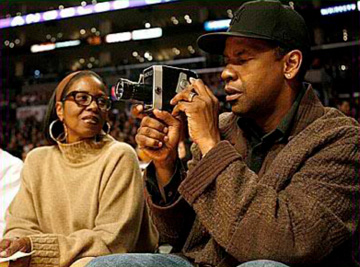
Denzel Washington using a classic 8mm movie camera
 
Julia Roberts uses film in her Leica
 
Brad Pitt likes using a classic Leica

Tuesday, May 8, 2012

My Favorite iPhone Photo & Video Apps.

Playing my Traveler guitar using my iPhone as an Amp. (photo by Anne)

I have been an iPhone fan since its inception and yes, I am one of those freaks that have gone through all five versions (iPhone 1, 3G, 3Gs, 4 and now the 4s) of this popular Smart Phone.  I just love the versatility of this gadget-- "a digital Swiss Army Knife."  With one tool, I am always carrying a virtual office wherever I go-- my telephone, my computer, my music and most importantly (as a photographer), a camera/videocamera.

I shot and edited this photo using the 1st iPhone

I shot and edited this photo using the iPhone 3G

When I got my first version of the iPhone, I just used the camera for casual snap-shots.  At 2.0 megapixel, the camera was just too "light" to use for anything more serious.  Since the phone came with some great Apps., I was always eager to upgrade.  I began using the iPhone for my Fine Art work after upgrading to the 3G.  There was only a megapixel difference, but I was able to clearly print my photos up to 8" x 10" (using the Camera Bag App.).  You can see the results of this initial foray in my "Grounded Series." Now with the 4s' 8 megapixel camera, I can leave my trusty compact Leica D-Lux 3 at home.

Here is an example of a photo I shot and edited with the iPhone 4s.

Although there have been a slew of lens attachments and gadgets that have been made to enhance the performance of the iPhone's camera, I never really used any of them personally.  Carrying attachments bulkier than the phone itself defeats the portability and ease the gadget offers.  My main attraction to the iPhone aside from its obvious convenience, has always been the availability of wonderful Apps.  To date, I have more than 400 Apps. on my current iPhone.

Here are some of photo and video Apps. I use regularly:

Friday, April 13, 2012

Canon's New Ultra Cameras: 1Dc and C500

The Canon Cinema EOS family with the new C500 and the 1Dc

Yesterday, Canon, Inc. announced two new cameras they will be introducing at this year's NAB - the Canon EOS 1Dc and the Canon EOS C500.  The two new EOS Cinema EOS cameras (Super 35mm) are 4K capable, with support for uncompressed Canon RAW file (still for 1Dc and motion for C500).
   

After the success of the hybrid 5D MKII and the 7D with Indie Filmmakers, Canon shifted its R&D to its products' video capabilities.  Last year, it created a new product line called Cinema EOS with the introduction of the C300.  Aside from pro-class cinema/broadcast cameras, the EOS Cinema family also features new pro-cinema lenses.  Faced with a shrinking consumer camera base (mainly due to cellphone cameras), the company is clearly shifting its focus to the professional motion imaging market.

Monday, April 2, 2012

Stewart Sy's Wild World

Stewart capturing beauty underneath the waves

Stewart Sy's love affair with nature and the wild started at a very young age.  Growing up in the Philippines, he fondly recalls spending a lot of his free time pouring over the catalogued back issues of National Geographic in the Xavier School library (we were classmates), dreaming of one day visiting all those exotic places and experiencing the grandeur of the wilderness captured by the magnificent NatGeo photographers.  After graduating from college (DSLU) in 1989, Stewart migrated to Canada to follow his family.  In Vancouver, he discovered a dive shop a few blocks from their house.  He signed up for a course, and the rest is history -- he has been diving now for more than 20 years.

Stewart discovered photography pretty much the same way, by accident.  People were curious about his new diving hobby and were badgering him about it.  So he finally decided to bring a camera with him during his diving expeditions to capture some of the beautiful things he saw underwater.  This second hobby also became an obsession.  Not only did he become a diving photographer, he liked photography so much that he became a part-time freelance commercial photographer too.  Aside from this, he runs two photography related businesses:  one that offers professional digital scanning services; and the other, a dealership offering aquatic photographic equipment and accessories.


Stu and I lost contact after we graduated from High School, so I was not aware of his photography until we reconnected in Facebook last year.  Stewart would post some of his work once in a while, and I was soon impressed by the consistency of his vision and skill.  He has an unmistakable artistic 'eye.'  According to him, he drew and doodled a lot when he was younger, but he never formally studied photography or any other art form.  Amazing, is the first word  that comes to mind, whenever I think of his photographs. 

I interviewed Stewart to get a better insight into his photography, his vision and his art:

Monday, January 23, 2012

Photography After Kodak


One of the biggest stories of the New Year, is Eastman Kodak's recent bankruptcy filing.  It made headlines the world over because it symbolizes the end of an era-- the end to the Age of Film Photography.  To film users everywhere, it was a death spell.  As a fan and Kodak film user, I mourn the good old days when film was the norm and great film stock was available everywhere.  I started my exploration of photography on Kodak film when I was a young boy.  As a film student in Art Center College, I used to buy my film stock directly from Kodak Hollywood in Santa Monica Blvd.  With Kodak forced to recognize its need to reorganize, film stock will soon become scarce (at least Fuji Film is still doing business) and film prices would surely skyrocket. Film photography will become more specialized and rarified.

But this Bankruptcy was not a surprise to anyone, everyone was expecting it to happen sooner or later.  The paradigm shift to digital photography has been happening for the last 20 years.  Eastman Kodak was just not savvy enough to remain on the forefront of the digital photography technology in the last 10 years, because it was busy concentrating a lot of its resources on mounting an aggressive stance to defend its shrinking core film business. 

The first Kodak digital imaging system built in 1975

Very few people know that Kodak built its first prototype all-digital camera in 1975.  The camera had a working CCD imager which digitize the captured image on a standard cassette tape.  The data was read by a playback device that interpolated the 100 captured lines to 400 lines, then generated a standard NTSC video signal, which can be viewed a television set.  In 1986, Kodak came up with the first megapixel sensor.  The company released 7 digital imaging products in 1987, capable of recording, storing, manipulating, transmitting and printing electronic still video images.  In 1990 it came out with the Photo CD system and proposed "the first standard for defining color in the digital environment of computers and computer peripherals.  In 1991, it released the first professional grade digital camera system (DCS) using a Nikon F3 body with a 1.3 megapixel Kodak sensor.  The company was in the forefront of the digital photography revolution, decades before companies like Samsung and Casio built their first digital camera.  So what happened?

Monday, November 7, 2011

The Ultimate Camera - RED Scarlet X


When I found out about this... I couldn't wait to blog about it too!

RED Digital Cinema has finally unveiled its long promised "ultimate camera," the RED Scarlet X, immediately after Canon annouced its new EOS C300.  The Scarlet has been hinted about for more than 3 years, but has not been formally launched until a few days ago.  In the wake of Canon's reveal, RED immediately responded with the Scarlet X to douse the excitement building around the EOS C300 -- The Scarlet X will be retailing at half the price (9K + to the C300's 20K) and will be available by December (the C300 will be available Jan. 2012).  These are exciting times indeed!

I call the Scarlet X the ultimate camera, because it can be used for both professional still photography and cinematic videography -- like the new generation DSLRs, but for high-resolution (4K) pro-cinema grade applications.  The other professional grade digital cinema cameras currently in the market (including the new C300) are all dedicated motion picture cameras.

The RED Scarlet X looks really good on paper, capturing 5K stills (Redcode RAW) up to 12 fps and 4K motion resolution to 30fps.  The camera is modular and is adaptable to any shooting scenario, be it still or motion, and can be fitted with an array of gadgets and accessories including multiple lens mounts (the camera comes standard with either a Canon EF or PL mounts). 

The RED Scarlet X configures both as a still or motion picture camera

Thursday, November 3, 2011

Canon Enters Pro-Cinema - EOS C300


When I found out about this, I couldn't wait to blog about it!

As a hybrid photographer/cinematographer I was somewhat personally disappointed by the new Canon 1DX that came out a couple of weeks ago.  It is impressive for what it can do (perfect for wildlife, photojournalism and sports), but I felt that it somehow stood in the middle of nowhere... The fastest still Pro at this point, yes, but it is neither the fattest DSLR for high-end still photography nor the most capable Digital Cinematography camera out there.  I am heavily invested in Canon lenses, so I've been watching Canon camera (both still and video) development closely.

Enter the new Canon EOS C300, with a Super 35mm CMOS sensor.  It uses a new DIGIC DV III Image Processor and 50Mbps 4:2:2 codec. Compact, modular and compatible with all existing EF and the new EF-Cinema lenses.  A PL-mount version is also available, the EOS C300 PL. 


Modeled after the Super 35mm 3-perf motion picture film, the C300's CMOS has an active image size of 24.4 x 13.5mm, smaller than the 5D Mark II (and the 1DX), but slightly bigger than the 7D (and the 60D).  6.4 x 6.4 micrometer photosites (photodiodes), with individual lenses, efficiently gather light.  Proprietary technologies embedded in each photosite simultaneously lower the image sensor's noise floor, while enhancing the photon capacity of the photodiode resulting in an impressive dynamic range.  


The sensor also employs an innovative readout technique that delivers full bandwidth individual RGB video components without debayering algorithms.  Each of these components has a 1920 (H) x 1080 (V) sampling structure at up to 60 frames. From the original video component, a 1080-line 60i format or a 1280 (H) x 720 (V) at 60P HD format are selectively derived.

The EOS C300 CMOS is the first Canon CMOS sensor designed for high frame-rate motion picture applications.  With its large Super 35mm sized sensor and the DIGIC DV III Processor this camera has a remarkably high signal to noise ratio, capable of delivering cinema quality images with superb detail and high dynamic range even with minimal light.

The camera also has a special Canon Log mode within the DIGIC III RGB video processing system, which enables the Cinematographer to manually set exposure values to fine-tune his or her footage for post-production purposes similar to the current DI process.

Tuesday, October 18, 2011

New Canon DSLR Flagship: 1DX


Canon, Inc. just introduced its newest "flagship" professional DSLR model, the EOS 1DX. It succeeds both the 1Ds and the 1D lines, combining the best of both worlds -- high-quality image with high-speed capture. The "X" in 1DX designates the cross-over or the merging of Canon's two pro digital lines; "X" also represents the 10th generation of professional DSLRs from Canon; and finally, "X" stands for X-treme.

The new camera uses not just 2, but 3 separate processors (2 DIGIC 5) to deliver full-resolution RAW or RAW+JPEG images at 12 fps, with a high speed choice of 14 fps at JPEG mode.  One sensor (DIGIC 4) is dedicated to the new 61 point high-density Reticular Auto Focus (41 cross-type points) and the 100,000 pixel ambient/flash RGB metering sensor, which gives the 1DX lightning speed focus and exposure accuracy capable of tackling the most demanding action and motion shots.

The new full-frame 18 megapixel (5184 x 3456 pixels) sensor features gapless microlenses and larger individual pixels (1.25 microns larger than the 1D Mk IV and .55 larger than the 5D Mk II). This gives the 1DX an ISO range of 100-51200, with an extended range of a low 50 and 2 high option -- to a maximum of 204,800.  This camera guarantees sharp low-noise images even in the most dimmest conditions.

The video capabilities of the camera have also been upgraded.  It is capable of 1080/30p/25p/24p HD video capture, with options for 720/60p/50p as well.  Downsampling errors as well as moire have also been reduced.  The 4GB file system limit has been improved with an automatic file splitting function, giving the camera almost 30 minutes of continuous video capture.  It also supports both intraframe (ALL-i) and interframe (IPB) compression, to aid post-production and editing workflows.  The camera supports two SMPTE-compliant timecode embedding (Rec Run and Free Run) to ease syncing multiple cameras in post.  It also supports manual audio control, with an option for external stereo microphone.

Canon also redesigned the shutter mechanism with lighter carbon fiber blades, making it more faster and more durable.  It is rated at 400,000 cycles.

For more information on the other new and improved features this camera has, please go to www.canoneos.com   

Here is a video of the New EOS 1DX:

--Photos from www.canoneos.com.  Video from Youtube.com by BryanMumble.

Tuesday, October 4, 2011

iPhone 4S


Apple just introduced the new iPhone 4S, the newly updated version of its popular smart phone.  As a photographer who uses the iPhone regularly as a camera (I've used all 4 previous models), I am happy to announce an upgrade on the camera of our favorite pocket/everyday phone-camera.

The camera on the iPhone 4S was upgraded to 8 megapixels from the 5 megapixels of the iPhone 4 (rear/main camera).  The lens was also improved to provide sharper and crisper images, with a slightly faster aperture of f/2.4 from the previous f/2.8.  The video capability was also increased from 30 fps 720p HD to 30 fps 1080p HD.

The other notable upgrades are the faster processor, new OS 5, better antenna (reception), higher capacity (new 64 GB model) and Apple's new talking voice activated task software, called Siri.

The iPhone 4S will be available in the US, Canada, Japan and most of Western Europe by October 14 and to 22 other countries by the end of October.

--photo taken from http://www.apple.com/

Wednesday, November 10, 2010

The Pleasure of Collecting Old Cameras

I have a growing classic camera collection. Every since I turned professional in 2006 and was required to go digital (Advertising and Editorial Clients require digital files nowadays), I became nostalgic about film photography and all the equipment that came with it. So I started buying a few of the older cameras I have always wanted.  Before I realized what was happening, I had more than 50 cameras in my possession.

In the not so distant past, when film was still in general use, cameras were built to last. I can personally testify to the durability and mechanical reliability of these cameras, since I still use a number of them, mostly Canons, including the first 35mm my father gave me in 1978.

Century Graphic Press Camera with Heiland Flash

New digital cameras are built to have short product lives.  Technological breakthroughs now happen within months, not years.  Camera manufacturers have to keep pace with the competition and the latest upgrades in hardware and software generated by the computer industry.  As a result, manufacturers have made it a point to build less sturdy cameras, employing plastics instead of metal alloys (Pro cameras are the exception) to ensure constant replacements and upgrades.  How else can they generate sales for the their latest models.  Most Digital cameras are "throw-away" gadgets, products that are cheaper to replace than to repair, making these modern cameras unattractive to collectors in general who value, quality, durability and exclusivity.

Film cameras on the other hand, with the exception of the "instamatic" point and shoot variety that became popular from the 70's onwards (including the late Advantrix), were built solidly and were manufactured to last. Indeed, you can find a good number of cameras from the 1970s and 1980s still accurately firing despite years of heavy use-- and this goes for both the consumer oriented models, as well as the top of the line Professional models. As you go backwards in time, you will find lesser pristine examples but they do exist, but of course at a steeper price tag. This scarcity, brought about by time and the fact that there were fewer cameras manufactured in the past, makes these particular models highly collectible and attractive to collectors.

Argus C-44 with Cintagon lenses, L44 meter and viewfinder

Wednesday, June 9, 2010

Mamiya RZ33 kit

Christmas in June ???? For Mamiya RZ photographers, it certainly is! Mamiya just announced a dedicated digital back for Mamiya RZs in a kit called "RZ33" (bundled with a RZ ProIID body).


The RZ33 kit includes a Mamiya RZ ProIID camera body with 33mp focusing screen, Mamiya cable-free Digital Integration Plate, Mamiya DM33 digital back & battery, battery charger, FW800 cable (for tethered shooting) and software.  The RZ ProIID body (which has been around for several years) of course features Mamiya's advance microprocessor technology through it's cableless MSC (Mamiya Serial Communication) system.  The Mamiya DM33 digital back (which I featured last October in this blog) manufactured by Leaf/Phase One/Mamiya features a 33 megapixel 48 x 36mm CCD 16 bits/channel sensor with a burst rate of 1.1 sec/frame and a 12 f-stop dynamic range.  It has a user selectable ISO range of 50-800 and a 6 x 7 cm touch screen LCD.  The ProIID body communicates with the digital back wirelessly through the special Mamiya RZ cable-free Digital Integration Plate which features RZ's unique revolving back, which provides horizontal or vertical composition without moving the camera body sideways.  

Tuesday, May 4, 2010

Affordable Waterproof Housing For Your Cameras

Dicapac WP-610

For a few dollars, anyone can waterproof, weatherproof or dustproof their cameras with a Dicapac waterproof case.  Made from high-quality PVC with Silicon and TPU Rubber, it is the perfect camera housing for swimming, snorkling, diving, boating, camping, skiing, rafting or simply as a proctective covering against rain and dust. It is currently available in twelve different configurations to fit consumer sized video cameras and still cameras (from SLRs to compacts).

I bought a Dicapac WP-610 case for my Leica D-Lux 3 and tested it last weekend in our pool.  I am glad to report that it is effective and well worth its price.  Here are underwater photos of my wife and daughter swimming:


Aside from the Leica D-Lux 3 and D-Lux 4, Model WP-610 also fits the Canon Powershot G Series and the Sigma DP Series. The case features a UV coated optical lens barrel with a front port diameter of 62mm and an additional 3.5 inch extension barrel for longer lenses.  A detachable neck-strap and foam insert (for better fit) are also provided.  The case is guaranteed to a depth of 33 ft. or 10 meters using a double seal system with a waterproof zipper, plus roll and velcro closures.

Another case I am interested in is the WP-S10, which can easily accomodate a Canon 7D or 5D Mark II.  It features the same materials as the WP-610 in a larger dimension and features a bellowing/extending barrel that stretches to 200mm (80mm diameter) to accomodate a variety of lenses. It also features a finger sleeve to access the shutter release and for reaching the top side camera control knob. It is guaranteed up to 16 ft. or 5 meters in depth.  This case will be perfect for most of my professional still and DSLR HD work, as a weather proof case and as an underwater housing for light diving needs.  It retails for a low $150!

Tuesday, April 20, 2010

Zeiss Compact Primes CP.2


I have been high on HDSLR technology for the past year. But I did not expect it to catch on this fast.  Carl Zeiss has just endorsed this growing market segment with a professional line of lenses specifically geared to these lightweight hybrids.

The company just introduced a new line of lenses with interchangeable lens mounts called the CP.2.  It offers great flexibility, enabling the filmmaker to use just one set of lenses for both traditional film and professional digital cameras as well as for HDSLRs.  Currently, the lenses are only available in EF (Canon) and PL mounts, but will soon be adaptable to the F (Nikon) mount as well.


The current lens range are as follows: 18mm/T3.6, 21mm/T2.9, 25mm/T2.9, 28mm/T2.1, 35mm/T2.1, 50mm/T2.1 and 85mm/T2.1.  All the lenses cover the full-frame image format (24 x 36mm), ANSI Super 35 and normal 35 image formats except for the 18mm which only covers Super 35 and normal 35.  The line features standard housing dimensions, standard focus and iris gear positions, longer focus rotation, consistent front diameter and manual focus -- features found in high-end professional cinema lenses. It also features a nine-blade iris and a "sweet-spot effect" for APS-C sensors. Coupled with superb Zeiss optics, these lenses are the perfect lenses for any cinematic or commercial application.

The individual prices are currently unavailable, but would probably range from $3,800 for a single lens and up to $28,000 for the current set.

Here is an interview by Cinema5D in this year's NAB on the new Zeiss lenses:


--Photos from Carl Zeiss Cinematography. Video by Cinema5D from You.Tube.

Monday, November 2, 2009

Canon EF Mount Zeiss Lenses

Carl Zeiss, Inc. just announced the newest addition to its ZE Series Lenses (Canon EF Mount), the Distagon T* 2/35 ZE.


The Zeiss Distagon T* 2/35 ZE is a 35mm standard wide-angle prime for all film and digital Canon EOS cameras models, with a wide aperture of f/2.  It features a moderate 53 degree field of view (horizontal) with very minimal distortion, perfect for commercial, travel and nature applications.  A manual focus fast lens that features a short angle of rotation for precision focusing, the 35mm ZE was made for professional handheld use.  Constructed with 9 high-definition zeiss elements and coated with the Zeiss T* anti-reflection coating, it easily captures bright light sources without unwanted artifacts.  Stylishly sleek and elegant with an all-metal mechanism, it compliments the contours and rounded body design of the Canon EOS cameras.

The 35mm ZE is the 6th lens from Zeiss available for the Canon EOS Series.  The other ZE Series Lenses are: the Distagon 18mm f3.5 ZE, the Distagon 21mm f2.8 ZE, the Distagon 28mm f2 ZE, the Planar 50mm f1.4 and the Planar 85mm f1.4.

The complete ZE Series to date is shown below:


Canon cameras with fine Zeiss lenses -- a dream of mine that has become a reality!

Manufactured under license by Cosina in Japan with Zeiss glass, it is available in a variety of camera mounts: Canon (ZE), Nikon (ZF), Pentax/Samsung (ZK) and M-42 screw thread (ZS).

For an in-depth review of the individual lenses, go to:  http://diglloyd.com/zf/index.html

The 50mm and 85mm Planar ZE lenses are available in Amazon.com:


--Photos from http://www.zeiss.com/