Showing posts with label art philosophy. Show all posts

Saturday, June 1, 2019

Speakers at AIFFA 2019

Anne and I found ourselves on a flight to Malaysia, just several hours after DAGSIN's last commercial screening. We were on a plane to attend the ASEAN International Film Festival and Awards (AIFFA) in Kuching, Malaysia for the 2nd time after 2017, when DAGSIN was among the "official" films selected to compete.


This time around, Anne and I had been invited to give a "talk" (about our experiences in producing DAGSIN, our two year journey though the festival circuit, and finally releasing the movie commercially, just a week prior) in AIFFA BIZ, the professional media industry portion of the festival.

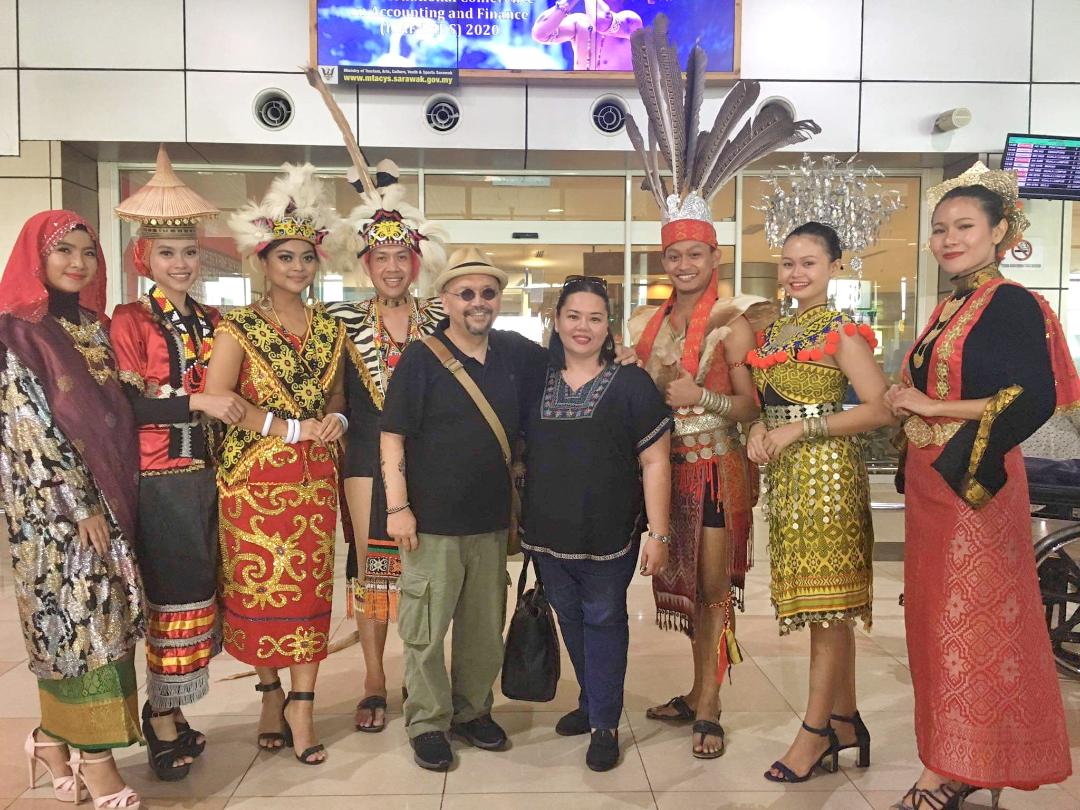
Atom and Anne with the welcoming party to Sarawak, dressed in their native costumes.
The Philippine Delegation to AIFFA 2019 at the Kuching Airport.
The Philippine Delegation this time around was smaller, despite the increase in the number of Filipino Films officially competing. We flew in with the Filipino contingent, but since we were booked in a separate hotel with the other ASEAN AIFFA BIZ participants, Anne and I still found ways to hang-out with our compatriots.

Atom and Anne with AIFFA heads - good friend Adelina Iskandar, Head of
AIFFA BIZ with husband Malaysian Actor Fish Fazil, Livan Tajang, AIFFA Festival Director and Filipino Filmmaker Joe Laban.
Atom and Anne with Filipino Direk Joe Laban and Direk Tikoy Aguiluz with the other Filipino Delegates.
Atom and Anne with writer Rody Vera, Cinematographer Rain Yamson and actress Elora Españo.
The Pinoys singing, drinking and hanging-out together in a Karaoke Bar.
Atom and Anne had their turn with the mic.
The Filipinos having lunch together almost every day.
The Filipino Delegation with AIFFA special guest Steven Seagal.
Anne with Philippine Director Tikoy Aguiluz and the other ASEAN filmmaker Jurors of AIFFA.
Our Talk was scheduled on the second day. After listening to the other "Talks" by various Media Professionals invited from all over the ASEAN, Anne and I began feel that maybe we were invited by mistake. Most, if not all, of the other Presenters are Commercial Production Houses and veterans of the industry, not only from Asia but also from Hollywood. So when the audience approached us one by one after our presentation, congratulating us both for DAGSIN and exclaiming how we inspired them to keep on making movies, Anne and I were both surprised and elated!

Atom discussing the intricacies of making DAGSIN. 
Anne summarising our three year long journey with DAGSIN,
from actual production, film festival runs and finally distribution.
The AIFFA awards night is a formal sit-down dinner affair that is televised nationwide in Malaysia and several other ASEAN countries. The Philippine Delegation came home with the most awards, including Best Film for Chito Roño's "Signal Rock and a post humous Best Actor trophy for Kristoffer King for his performance in Howard Yambao's "Kristo."

The AIFFA Awards Night inside the Ballroom of Kuching's most prestigious hotel. 
Atom and Anne seated with their fellow AIFFA Speakers,
who have since become business associates and friends.
Atom with Mell Navarro and AIFFA Lifetime Achievement Awardee,
Indonesian filmmaker Slamet Rahardjo.
The Philippine Delegation celebrating our sweep.
With actresses Teri Malvar and Mai Fanglayan and AIFFA hosts Rovilson Fernandez and Marc Nelson.
The Philippine Delegation celebrating the multiple win on the AIFFA stage.
Anne and I were scheduled to leave on April 28 so that I can celebrate my birthday in Manila, but  our good friend Adelina surprised us by extending our stay for an extra day and offered us our own driver and car so we can tour Sarawak. We had been to Kuching before, but we did not have any time to go around. Anne and I were just so grateful to be finally given the chance to see some of Sarawak.

As we were having breakfast in our hotel dinning-room in the morning of my birthday, the hotel staff surprised us with a birthday dessert. Adelina Iskandar, AIFFA BIZ head, who was directly responsible for our participation in AIFFA 2019 and our extra tour day, was also behind this special birthday treat for me. Thank you, thank you so so much Adelina! I hope one day we can return the favour and treat you and Fish to a wonderful holiday in the Philippines.

Atom and Anne at the AIFFA Awards Night with good friends, Malaysian Power
Couple Adelina Iskandar and Fish Fazil, and Philippine Press veterans Mell Navarro and Pilar Mateo.
Atom's special birthday dessert surprise from the staff of the Kuching Waterfront Hotel.
Atom and Anne delighted by the surprise birthday dessert.
Atom and Anne on tour on our extra day in Sarawak.
I fell in love with the Sapek, the Bornea Guitar. I will definitely buy one someday.
-- All photos are the exclusive property of Atom & Anne Mediaworks, Corp.

Friday, January 11, 2019

Creating Dagsin's Screenplay

!!!! SPOILER WARNING !!!! **Do not read if you have not seen the movie**

"Dagsin" ("Gravity" in English) took twenty years to evolve into a movie. I originally came up with the prototype of the story when I was still a film student at the Art Center College of Design in Los Angles in the mid-1990s. The original short-film screenplay was then titled, "This Mortal Coil," and it was submitted as an exercise/assignment for my Screenplay Writing Class. It was just eight pages long, and it only contained what eventually ended up as the "climactic scene" in the finished movie.

Tommy Abuel as Justino Razon, with Lotlot De Leon
as his adopted daughter Mercy and Sue Prado as his
Private Nurse Grace.
The original short script told the story of an old paraplegic resident of an American Retirement Home-- a wheelchair bound man (originally Caucasian) who recently lost his wife of fifty years. Wandering into their apartment after her Interment, he feels the weight of his sorrow so strongly that he decides to hang himself from the ceiling rafters of their bedroom.

I was going through a rough phase in my love life at that time that the Romantic in me chose to write about an ideal relationship, where someone was so in love that he would be completely devastated at the lost of his beloved-- a storybook type of Love Story. Besides, the idea of a wheelchair bound paraplegic man hanging himself with his feet still touching the ground yet powerless to escape his chosen fate (self-pity can soar with imagination), was such a strong poetic image, indelibly cinematic and memorable that it would guarantee me a good grade for the class!
   
Years later, the original seed concept for "Dagsin" resurfaces. After writing half a dozen full-length feature spec. scripts, I was looking for a short-film project to jump start my filmmaking career and "This Mortal Coil" was the prime candidate. So I began rewriting the original script, since I thought that the suicide sequence was not strong enough to stand by itself. But as I added simple flashback sequences, it started to get longer and longer. Soon, it was twenty pages long and that was just the backgrounder to the love story, I haven't even begun to say, what I really wanted to say.

By definition, a short-film is just about eight minutes long (or an 8-page script). Anything longer than that, and your chances of entering it in a major international competition gets slimmer and slimmer. Cannes for example only accepts 15 mins. maximum for their Short Film entries. Knowing that my story has potential beyond being just a short movie, and understanding that short films do not have a commercial market, I then committed to writing the story I really want to tell no matter how long the screenplay ended up becoming. During that time, I was already married for more than ten years (found a partner I want to spend my life with), had kids and recently suffered a Stroke. I wanted the story to reflect everything I have learned and have gone through in my life up to that point. Thankfully the first draft I wrote totaled just one hundred twenty pages in Movie Magic (Hollywood standard Screenplay Software) - which counts each page to be roughly equivalent to a minute of screen time.

Benjamin Alves as Young Justino Razon, Janine Gutierrez as Young
Corazon Bishop (Mrs. Razon) and Alex Diaz as John Bishop, Jr.
in the flashback sequences.
The first thing I incorporated to my original story was the flashback sequences. I knew by instinct that I had to make my viewers fall in love with my main characters first, for them to empathize with the loss they will be experiencing as the story unfolds. Making the audience spectators of the romance between Justino and Corazon from the beginning and making them experience the love that develops between the couple through the years, was my main goal. It was a deliberate decision on my part to make the film essentially a "Love Story" in terms of classification and genre, since the main theme of the movie even then was "only Love can save us from the pain and tragedies of life."

The historical breath and timeline of the story came naturally when I plotted Justino's life in reverse. By his present age, he would have been born in the 1920's and would have gone through World War II and the Martial Law era in the 1970's. The decision to place him at the front row of these major events as they unfolded was elementary. Since he was an action oriented man (idealistic, heroic and strong-willed) who would eventually be crippled by the very nature of human existence, making him an active participant in the critical periods of our country's history would effectively magnify the tragedy and irony of his fate. It was at this point of writing when I realized that Justino was a classic "Sisyphean" character.

Thursday, November 22, 2018

DAGSIN's Artistic Statement Published for the 1st Time

Souvenir Program for the 4th Danish Film Festival
 
An excerpt of my Artistic Statement/Director's Notes for DAGSIN was published publicly for the first time in the 4th Danish Film Festival's (Manila) Souvenir Program. The article outlining my artistic considerations and directorial approach in constructing the movie was originally a part of the dossier we submitted to the Cinemalaya Selection Committee in 2015.  
 
Sponsored by the Royal Embassy of Demark, the yearly Danish film festival gives Filipinos a chance to sample the newest crop of award-winning Danish movies. This year, aside from 8 Danish films, the Embassy decided to include the first Filipino Movie in its line-up-- DAGSIN. Unknown to most Filipinos, DAGSIN was directly inspired by the ideas of Danish Philosopher Soren Kierkegaard and French Existentialist Albert Camus. A fan of Kierkegaard, Danish Ambassador to the Philippines Jan Top Christensen thought that DAGSIN would be a perfect fit to illustrate the goodwill and healthy relations that has existed between our two countries for more than a century.
 
Knowing that the audience might get confused at the inclusion of DAGSIN in their festival, Danish Cultural Officer Angelo Cruz made it a point to include an excerpt of my Notes in their Program. We never openly advertised these ties to Kierkegaard and to Camus thinking that they are not particularly relevant to the overall public perception and enjoyment of our film; but now that it is out there, we hope that you now watch DAGSIN with the added appreciation for the thought and meticulous craft we invested in making this movie.


ARTISTIC STATEMENT/DIRECTOR'S NOTES for DAGSIN

"Dagsin" or "Gravity", alludes to the “heaviness” of life, the trials and tribulations we experience as human beings. It refers to the heaviness we feel when we are burdened by life and all its tragedies— the weight of emotion that assails us, when someone we love dearly passes away or when we are weighted down by unresolved guilt. Gravity also metaphorically describes the force that attracts and binds us to one another… Love.
 
Inspired by the ideas of Danish Philosopher Søren Kierkegaard and French Existentialist Albert Camus, the movie's main plot is simple but we have richly layered the movie with sub-plots (World-War II and Martial Law), characters, symbolisms and metaphors to illustrate how Love can shelter us from the tragedies of life. The most obvious examples are the names of the characters: Justino (for Justice or conscience/the conscious mind), Corazon (heart/the unconscious), Mercy (God's Mercy), Nurse Grace (God's Grace), etc.; and of course the story’s timeline, which exactly coincides with Holy Week (Palm Sunday to Easter Sunday).
 
The whole movie is shot, paced and edited from Justino’s subjective perspective, reflecting both his mental as well as physical states— the memories of his youth are deliberately more vivid and idyllic (mimicking the sentimentality of old Filipino Romantic films from the 1940s and 50s), in contrast to his present which is more slow, somber and funereal in feel. The camera is static most of the time to emphasize Justino’s paraplegic immobility, except when we are objectively observing him from another character’s point of view.

I used the location itself, an old mansion, to magnify Justino's predicament. Grand but now nearly abandoned and falling apart, the house mirrors its owner, who is now old, worn-out and nearing his end. Like a ghost, Justino wanders within the shadows of his past entombed in this mausoleum of memories.
 
Although the movie can be classified in a number of ways: Drama, Romance, Arthouse, etc., I personally categorize it under "Noir," because "Dagsin" is actually a crime, suspense drama of sorts, where the perpetrator, the victim and the executioner are one and the same person. A respected and venerated Judge during Martial Law who compromised his integrity in exchange for the safety of his wife, Justino's conscience now haunts him and insists on passing judgment on his past sins.
         
In the end, “Dagsin” is one man's "soliloquy" of desperation for his departed love, his soul and his God.

*This statement was a part of the dossier submitted to the Cinemalaya Selection Committee in 2015 and its excerpt (highlighted in yellow) was first published in the souvenir program of the 4th Danish Film Festival in Manila hosted by the Royal Embassy of Denmark.


Thursday, March 23, 2017

Elevate Your Selfies Into Self-Portraits

(Click on Photos for better viewing)

 
A phenomenon of the Social-Networking Age we live in, "Selfies" have become as common place as ID photos in the albums of our digital lives. Most people use it to show the places they have been to, the memorable events they have participated in or the times they spent with friends or loved ones, but a big number of people (particularly women) use it more as mirrors to take snaps shots of their faces or bodies (maybe to see how other people see them), to assess their physical appearance-- as personal data to be used either as negative evidence (to determine what can be improved upon) or positive feedback (to proudly display what they have and others do not). Psychologists have been alarmed by this growing "Selfie" trend, which they have diagnosed to be symptoms indicating Narcissistic Disorder.

 
The "Self-Portrait" is a time honored artistic endeavor practiced by most Western Painters and Photographers for centuries. Rembrant and Van Gogh, as well as Avedon and Cartier-Bresson often used themselves as subjects for their own work. Like them, I believe in using my image as an element in my photos, drawings, paintings and maybe even in my films (in the future). Like them, my Art flows from my sense of Self-- my history, my experiences, my perspective, my psyche, my thoughts, my spirituality-- in other words, my soul!


The Buddha says, "that the Self is an illusion... Life itself is an illusion!" Since wholly I agree with this premise and believe that our sense of "Self" is a reflection of our mind, "Self-Portraits" for me are visual reminders of my very existence, my physical presence. I think most artists, particularly the more sensitive and philosophical ones, are perpetually aware of the impermanence of all life. It is this sense of impending doom that propels Creatives to value beauty and the majesty of life, and drives them to express themselves through Art. What is Art anyway but an individual's recreation (or reconfiguration) of one's personal experiences, one's perspective of life/reality-- our ultimate validation of our own existence.

 
Painting or photographing ourselves keeps us in touch with our core... our Selves... the Being that consciously contemplates life and living. Sometimes we have to see ourselves from the outside to understand what is happening inside (our minds). "Self-Portraiture" for me, is a form of meditation or self-reflection/contemplation that can make us understand ourselves better, both in form and in substance. It is narcissistic in a way, but it can be profound if it ventures beyond the physical into the psychological.


"Selfies" are actually just a level away from becoming serious "Self-Portraits." The only difference I can see between the two is "artistic intent." "Selfies" are mostly snap-shots taken without much thought. "Center yourself (or at least see some part of yourself), then shoot" is the only instruction anyone has to follow. "Self-Portraits" are more deliberate. Framing, Focus and light (or the lack thereof) must be considered before the shot is taken, resulting in a more contemplated and conceptual photograph.

Tuesday, December 23, 2014

Booklist for the Holidays

I love reading, and collecting books is a passion of mine. So this holiday season, I have selected 15 books on photography, cinema and the visual arts from my own library to share with you. Most of these books just came out this year (all are still in print) and should be available in your local bookstores.

Vacation time is a good opportunity to catch up on some reading-- in between family gatherings and binge feasting:)  I have read all these books from cover to cover, and have found them invaluable to my own work. I hope you find some of them helpful to you too...

Have a MERRY CHRISTMAS and a prosperous NEW YEAR!

Have you ever wondered how one work of art could be sold for millions, while another can be almost worthless? Michael Findlay examines this phenomenon in his book, "The Value of Art." He demystifies the process of how art is bought and sold, its commercial and social dimensions while constantly looking beyond the sales numbers to emphasize its essential cultural and spiritual dimensions. As a trained financial analyst, I have always been fascinated with "value" and how we give or assign "worth" to objects and experiences. This book is an enlightening guide to the perplexing and amusing business of Art, for the curious.

Although I also paint, I included this book on this list primarily because I believe that portrait photographers (and cinematographers) can learn a lot from studying formal Portraiture. I can trace a lot of my skills in capturing expression, gesture, personality, emotion and soul (to accurately capture character), through my personal experience of painting and sketching people. When you look very closely at each line and shade on a person's face, taking note of how each muscle contracts and relaxes, you become hyper aware of how our bodies openly express our inner state. "The Society Portrait - from David to Warhol" traces formal Portraiture's development from Napoleon's time to the present, highlighting its progress from one art period to the next-- delving into the changing outlook of society from generation to generation. The book is filled with examples from major of artists, we can all learn from.   
 
"The Passionate Photographer" by Steve Simon is a great book that fills the gap left-off by most "how to" photography books-- mastering the craft psychologically, translating ideas and thoughts to create great images,  dealing with your fears, gaining inspiration and passion for your art. It is filled with great insights, real world examples and practical tips on how to improve your photography and bring it to the next level. I am already passionate about my work, yet this book has helped me focus on the details of what can make my photography consistently exceptional, and at the same time help keep me inspired.  
 
Arnold Newman is one of my favorite master photographers. His photography has inspired me from the very beginning and has been one of the main influences for my own portrait work. The book, "Masterclass - Arnold Newman, contains more than 200 examples of his work including iconic portraits of Henri Cartier-Bresson, Brassai, Pablo Picasso, Salvador Dali, Marcel Duchamp, Mark Chagall, Max Ernst, Andrew Wyeth, Piet Mondrian, John F. Kennedy, David Ben-Gurion, Robert Oppenheimer, James Watson, I. M. Pei, Isaac Stern, Leonard Bernstein and Martha Graham among many other famous and notable sitters. It also contains a section on Newman's development as a photographer, from his apprenticeship in a portrait studio in the early 1940s to his gradual experimentation with the form, and finally to his own signature abstract, simplified, cropped style that I fell in love with. I highly recommend this book for all Arnold Newman devotees.
 
John Harrington is the president of the White House News Photographers Association and has worked for the Associated Press, the New York Times, the Washington Post, Time, Newsweek, the National Geographic Society, People and Life. His book "Photographs from the Edge of Reality" takes us inside his career as a photojournalist, from the spring of 1990 when he gained his press pass to shoot President George H.W. Bush and Soviet leader Mikhail Gorbachev, to his work with current President Barack Obama. I love looking into other people's experiences, and this book gives me a window into the life of a photographer working in the White House, a rare treat.
 
I highly recommend the "The Street Photographer's Manual" for anyone starting out in "Street Photography." It is the most comprehensive "how to" book I have encountered regarding the genre-- a real manual that covers everything you will need to know to start shooting. But "Street Photography" is so broad and highly individualistic that knowledge beyond this guide, can only and will only be acquired once you shoot... and shoot... and shoot for years to come. David Gibson covers as much of the basics you will need to know, with great examples from his own work and portfolios from other well-known practitioners. I disagree with some of the parameters he suggests in the book, but "Street Photography" is a subjective field and there is no way anyone can definitively tackle every detail.
 
"The New Street Photographer's Manifesto" is a more condensed version of the previous book. Like "The Street Photographer's Manual" it gives great tips and technical information on how to start shooting "Street," but in a more compact and economical package. Tanya Nagar provides good examples from practicing street photographers as a guide. To me, this book is a good enough backgrounder on the genre to start from. I recommend it highly as a great "stocking stuffer" for any would be street photographer on your list.

Wednesday, December 3, 2014

Why I Shoot "Street"

My favorite "Street" film camera, a 1960s B&H Dial 35

To go forward, we sometimes have to step back...
 
That is exactly what I did when I decided to branch out formally into "Street Photography," six months ago. After being involved in the Photographic Arts for more than a third of a century, the practice of taking photographs was beginning to lose its magic. From an amateur hobbyist, I had successfully transitioned into a professional who specialized in commercial studio photography. But after years of doing that, photography became "work" and I lost the yearning to photograph anything outside of the "studio," without the "proper" camera set-up-- lenses, filters and lighting equipment. It became so bad, that I actually refused to bring a camera on vacation for several years (even during my Honeymoon, w/c my wife still refuses to forgive) thinking that it would be better to miss a shot than to execute one that was crappy-- of course, I was being seriously philosophical about all this. To me, it was a real choice between bringing tons of heavy equipment or bringing nothing at all, so I gave my wife the lame excuse that it was better for both of us if she just brought her own camera, because she would just lose her patience with me lugging a heavy bag on our vacations, then waiting around for the "right light" to present itself. In truth,  I actually did not want to be weighed down by anything whatsoever when I was on R&R, preferring to "live for the moment" than to be burdened by necessity.
 
"Levitation" Los Angeles, USA (shot on film)

I have been a student of "Zen" since I was a teenager-- reading books as well as practicing "Zazen" in private. I got into Zen Buddhist philosophy because I was practicing Martial Arts during that time and was attracted to the spontaneity it brought its practitioners, particularly to artists. For a while, I even regularly attended early morning "Zazen" sessions with the Monks in the Zenshuji Soto Mission Temple in Los Angeles, and contemplated monkhood. But my photography went the opposite direction. As I got more involved with photography and cinematography while formally studying these disciplines in film school, I slowly associated the process of making good pictures with deliberateness and precision-- with the methodical studio-based approach espoused by Hollywood. I became engrossed in the graphic simplicity and idealistic formality of studio photography, particularly in Fashion (Avedon, Penn, Newton) and Portraiture (Karsh, Newman, Halsman). To me this type of photography was beautifully "Zen" like in spirit; but learned, at the same time, that the techniques involved in their execution were consciously methodical. Their measured quality appealed to me deeply-- both aesthetically and emotionally. So I strove for this standard in my photographic work for years, after all isn't "art" rooted in "art"-ifice? But this rigid approach gradually boxed me in.

"Hound Dog" Los Angeles, USA (shot on film)

Of course I admired master photojournalists like Henri Cartier-Bresson, Dorothea Lange and Sebastiao Salgado for years. But their type of photography belonged in an alternative universe to mine. I thought that there was a natural chasm that existed between "idealism" and "realism" in photography, that I came to believe that studio photographers and photojournalists were distinguished not only by their specialties and skillsets, but also by their personalities-- which I imagined to be polar opposites. For a long while, I firmly identified with the "photo-romanticists" (editorial and commercial photographers), who created images from their mind's eye, and not with the "photo-realists" (news and documentary photographers) that dealt with the more messier and unpredictable images from real life. I confused specialization as a choice between these two opposing camps.

Boy was I wrong! Because after much soul searching, I found out that like my photojournalistic brethren (and sisters of course), I do have a natural predilection for photographing/filming people more than any other subject. Like them, I am also curious about people-- I love stories and find nothing more compelling to capture on camera than human drama. I other words, I finally realized that I am a voyeur by impulse!

"A Brief Interlude" Hong-Kong, China

Saturday, August 23, 2014

Being Sensible About Street Photography

My daily weapon of choice: Fuji XE-1 with the 27mm pancake lens
 
I am skipping the 13th week installment of my "Weekly Street Photos" to write an essay about my own personal beliefs on the practice of "Street Photography" in general. 
 
I am avoiding no. 13, because it seems to be a general practice the world over (even my apartment building ridiculously omits listing a 13th floor on the elevator). Since a lot of people subscribe to this superstition without actually questioning its Templar origin, must I follow their lead blindly? If you agree, then please stop reading. What I am about to say, might seem offensive to you!
 
For the sake of argument, I should probably start referring to my "Street" photos as "Street Documentary" or "Street Photojournalism," because the term "Street Photography" apparently comes with a lot of baggage. Some street photographers I've come across are so dogmatic about the term "Street," they insist that "real practitioners" of the art should stick by a prescribed set of rules-- that encompasses, not only the aesthetic qualities that each photograph must contain, but also on what subjects can be included, where it must be shot and what equipment should be used.

As a commercial photographer who has shot hundreds of commissioned work on assignment, street style photography attracted me specifically because of the implied freedom to shoot anything I want, when I want, in any way I want. If what I am doing is not "Street" in the strict sense of the term, please tell me so I can stop referring to it as "Street Photography." The hard-core zealots of the movement should not worry, since I use the term loosely-- I literally shoot outside on the streets. If a lot of people have objections on my personal methodology or aesthetic choices, "Personal Documentary," "Street Documentary," "Street Photojournalism" or even "Street Safari" are equally good labels I can readily substitute to refer to the type of photography I do.

"The Hunter" Hong-Kong

Whenever I photograph out on the street freestyle, I feel like a hunter stalking game-- aiming to capture fleeting images of 'life' as it flows around me. All at once, I feel connected to my surroundings, at peace with the moment and one with my camera. This wonderfully fulfilling intimate connection to the world is driving me to pursue this type of photography with a passion that borders on the obsessive, and motivates me to carry a camera every single day.
 
I have come full circle. When I got into photography 36 years ago, I was essentially a street photographer-- I shot anything and everything around me that caught my attention. I transitioned into amateur photojournalism when I became the photographer for the school newspaper and yearbook. We still used film back then (early 80s), so I also learned how to develop my negatives and print my photographs in the darkroom. I neglected my photography for a couple of years during the time I was in college, and for a few years after that; but formally studied it (with cinematography) when I went back to film school in the mid-90s, then finally pursued it as an alternative career 8 years ago. I got back into personal documentary photography when I began using the Fuji X system earlier this year, because the cameras are delightfully compact yet can deliver high quality professional images in almost any environment.
 
It would be a tragedy to put something as magical as "Street Photography" inside a box. I agree that rules and limitation can sometimes breed creativity; but it does not work for everyone all the time, particularly for those who engage in Street Photography for sheer pleasure, not merit or acclaim. Rules are for contests and competition, not Art. The limitations (or restrictions) of an art form naturally springs forth from the limitations of the medium itself-- never prejudice. Dogma breeds a certain cerebral paralysis that goes against spontaneity,  the very instinct needed to cultivate good documentary photographs.

Tuesday, April 9, 2013

Perception and Imaging


"How we see" and "what we see" have always been facinating to me.  I have always professed that we see with our minds, more than our eyes -- because informational pattern and meaning can only be comprehended by filtering it with our brain.  The "eye" is of primary importance because it is where light enters and is focused, but only after we have perceived order in the shapes, colors, shades and textures mentally do we really "see" and give meaning to the visual information we receive.
 
"Gestalt psychology" has been studying visual perception and how we see since the 1920s.  Gestalt psychologists believe that the brain is holistic, parallel and analog, with self-organizing tendencies. They believe that our minds have an innate tendency to see patterns first, before analyzing details; or that we have a tendency to see 'relationships' between individual components as parts of a 'whole,' whether they were intentionally assembled or accidental. The "gestalt effect" is the form-generating capacity of our brain to see figures and whole forms instead of a collection of random lines, shapes or shades.
 
"Gestalt perception" is illustrated in these examples
 
A few "Gestalt" principles
 
"Perception and Imaging: Photography - A Way of Seeing" is a guide to this facinating world of Gestalt perception. Written by an expert in the field of Photography and Imaging sciences, Richard Zakia, the book throughly examines visual perception and presents a compelling perspective on "how we see."  Richard is Professor Emiritus at the Rochester Institute of Technology and served as chair of the Fine Art Photography department and the Graduate Program in Imaging Art. He has written 13 books on photography and was the prodigy of Rudolf Arnheim, art and film theorist, perceptual psychologist and the leading proponent of gestalt perception.